
If you search “Hobart stadium” in 2026, you’re not really searching for concrete and seats. You’re searching for a bigger answer. You’re searching for the shape of Tasmania’s sporting future.
And honestly, that’s what makes the Hobart stadium conversation more interesting than a standard infrastructure yarn. It’s not only a construction project. It’s a sporting identity project.
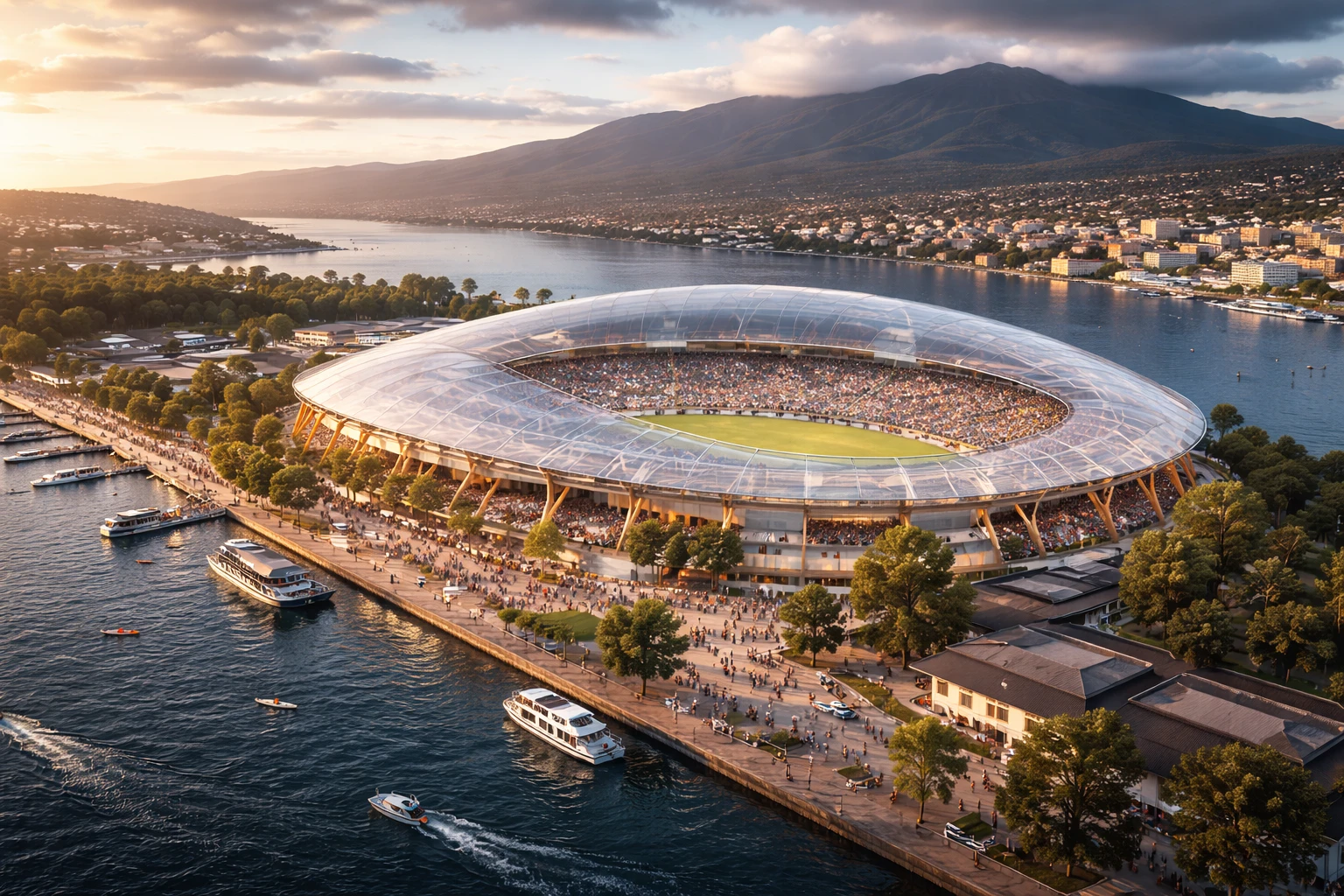
Right now, when people say “Hobart stadium,” they usually mean the proposed Macquarie Point stadium on the waterfront. That is the venue designed to become the future home of Tasmania’s AFL club and a multi-sport, all-weather events venue for Hobart. It is planned as a 23,000-seat roofed stadium, and after a lot of noise, delay, argument and redesign work, it is now moving through procurement with current expectations pointing to the 2031 AFL season rather than the earlier hopes of 2029 or 2030.
That is the fact side of the story. But the emotional side is what keeps it alive. This stadium has become a kind of test. Can Tasmania build something bold enough to change its sporting ceiling without losing the local feel that makes Tasmanian sport matter in the first place? That’s the real question sitting underneath the renderings.
First things first: which Hobart stadium are we talking about?
This matters because the phrase is a bit slippery. Hobart already has a known major venue: Ninja Stadium, the current name for Bellerive Oval. That ground has hosted AFL, cricket and some genuinely memorable Tasmanian sporting moments. It still matters. It still will matter. And for the next few years, it remains central because the Tasmania Devils are expected to use existing venues before the new waterfront ground is ready.
But in current public conversation, “Hobart stadium” usually means the Macquarie Point project. That’s the big one. The debated one. The roofed one. The one with the Devils tied to it. The one that has shifted from vision to approved project, and from vague promise to an actual procurement and delivery challenge.
That distinction is important, because the two venues are not really rivals in a simple sense. One is the current sporting workhorse. The other is the planned future flagship. And Tasmania is now living in the awkward overlap between the two.
| Venue | What it is | Why it matters now |
|---|---|---|
| Ninja Stadium | Hobart’s existing major oval at Bellerive | It remains one of Tasmania’s key venues while the new stadium is being delivered |
| Macquarie Point stadium | Proposed 23,000-seat roofed waterfront venue | It is the future-focused project most people now mean when they say “Hobart stadium” |
| York Park / UTAS Stadium | Launceston’s established AFL venue | It remains part of Tasmania’s two-city football footprint, at least in the short term |
That table clears up the geography. Now for the bigger part: why the new stadium matters so much to sport.
The stadium is tied to the Devils, but it’s bigger than the Devils too
Most Australians know the basic frame by now. Tasmania’s AFL future has been closely tied to this stadium project. That connection is not decorative. It is structural. The Tasmania Devils are due to enter the AFL in 2028, but the new Macquarie Point venue is not expected to be ready until the 2031 season. Until then, the club is expected to use existing grounds, including Ninja Stadium in Hobart and York Park in Launceston.
That timing tells you two things at once.
First, the stadium matters because it is the long-term home of the club in the clearest emotional sense. It is the place the Devils are supposed to grow into, not just visit. It is meant to feel like the club’s centre of gravity.
Second, the club is now real enough that the stadium question has moved beyond theory. The Devils are not some vague dream any more. They have a name, a shape, a trajectory and a future competition life that is approaching quickly. So when people ask about Hobart stadium, they’re also really asking: what kind of AFL home does Tasmania deserve, and how long is the gap between launch and arrival?
That gap matters. Clubs build identity in places. Temporary arrangements can work, but they always feel slightly provisional. A true home venue gives a side texture. Ritual. Habits. Noise that belongs to it. Landmarks fans associate with it. Shared memory. That’s what the future Hobart stadium is meant to give the Devils — not just capacity, but belonging.
- It gives the Devils a long-term anchor in Hobart.
- It turns Tasmania’s AFL presence from borrowed space into owned space.
- It gives southern Tasmania a venue that feels purpose-built for the next phase of elite sport.
That’s why people keep arguing about it. Nobody fights this hard over things that don’t feel symbolically loaded.
The roof is not a gimmick. It’s the whole personality of the project
You can’t talk about the new Hobart stadium without talking about the roof, because the roof is not a little design flourish. It is the defining feature.
The project’s design is built around a fixed dome roof using ETFE, supported by steel and timber. Official design material describes the stadium edges at 22.5 metres and the highest point of the roof at 51 metres. That roof is meant to make the stadium usable in all weather, all year, and to make it much more than a fair-weather footy bowl.
That matters in Hobart. Tasmania’s weather is not the country’s biggest enemy, but it is absolutely part of the story. Hobart may be one of Australia’s drier capitals in raw rainfall totals, yet it still deals with enough wet days, shifting light and chilly conditions to make all-weather reliability a very real sporting advantage. This is where the roof starts looking less like a luxury and more like a serious strategic choice.
And then there is the cricket angle. A huge part of the design work has gone into answering one question: can a roofed stadium still work properly for cricket? That issue has not been ignored or wished away. It has been tested. The ETFE roof system has gone through shadow and light testing, and officials have been working with Cricket Tasmania and Cricket Australia on whether the internal playing environment can feel safe and usable.
That is a big deal because the roof changes the stadium from “another oval” into something more unusual. A sports venue that tries to reconcile AFL, cricket, concerts and year-round use on a constrained waterfront site is not a standard Australian brief.
It is ambitious. Slightly strange. And very Hobart, in a way — a project small enough to feel locally argued over, but bold enough to make the sporting world pay attention.
Why the cricket question still matters so much
If this were only an AFL story, the design conversation would already be simpler. But it isn’t. Cricket is baked into the Hobart stadium debate because Tasmania is not going to build a project of this scale and then casually accept that it doesn’t really work for summer sport. That was never going to fly.
And to be fair, the project team seems to know that. The roof test rig installed in March 2026 is not random window dressing. It exists because cricket bodies wanted stronger evidence around shadows, light consistency and actual playing conditions. That’s sensible. Cricket, unlike some other field sports, is extremely sensitive to the quality and consistency of light. A tiny visual issue can become a major sporting issue very quickly when a hard ball is travelling at speed.
So the positive signs from the latest testing matter. They do not finish the conversation. But they help shift it from “this sounds risky” toward “this may actually be workable if the design keeps responding properly.”
That distinction is huge for Hobart. Because if the stadium can genuinely work for both football and high-level cricket, then it becomes a far more powerful sporting asset. It stops looking like a one-code compromise and starts looking like a venue with a truly different national role.
| Feature | Why it sounds exciting | Why it needs careful work |
|---|---|---|
| Fixed dome roof | All-weather events and year-round use | Playing light and shadow must still work for cricket |
| ETFE roof material | Lightweight, modern and visually distinctive | The feel of the light underneath matters as much as the look from outside |
| Waterfront location | Gives the venue a real sense of place | Build complexity, access and site preparation all get harder |
| Multi-sport design | Makes the venue useful in more seasons | Every sport asks for something slightly different from the same building |
That’s the balance. The very features that make the stadium feel special are also the features that make it harder to get right.
It’s not just about seats. It’s about atmosphere
One of the funny things about stadium debate is that people get stuck on numbers. Twenty-three thousand. Not enough. More than enough. Too small. Just right. And sure, capacity matters. It affects demand, atmosphere, revenue and flexibility. But if you ask sports fans what they really want from a venue, they often talk less about the raw number and more about the feeling.
Will it be loud? Will it feel close? Will it hold noise instead of letting it drift away? Will it feel like a home ground, or just like a large neutral bowl with nice architecture? That’s the bit that can’t fully be read off a planning document.
And for Hobart, atmosphere matters enormously. Tasmania’s best sporting environments tend to feel intimate, sharp and proper. They don’t always rely on mass. They rely on density of feeling. The crowd sounds close to the game. The place feels local. People care because the venue doesn’t feel like it belongs to a distant sports machine. It feels like theirs.
The hope around the new Hobart stadium is that it can hold onto that character while still stepping up into a different class of venue. That is harder than it sounds. Plenty of new stadiums look impressive and feel generic. The trick is to build something modern without bleaching the life out of it.
- Fans want the venue to feel distinctly Tasmanian, not interchangeable.
- They want noise and closeness, not only scale.
- They want the place to work for major sport without feeling overbuilt for the city around it.
That is the emotional design brief, whether the architects call it that or not.
What the delay to 2031 really changes
This is where the sports story gets a little awkward. A lot of people hoped the new Hobart stadium would be ready much earlier. That now looks unrealistic. The current target is effectively the 2031 AFL season, with site works and procurement moving ahead now, but the main stadium structure not expected to begin rising until mid-2027.
That matters because it stretches the gap between the Devils’ entry and the arrival of their intended long-term home. The club can cope with that in practical terms — existing venues will be used, and that has already been built into the short-term sporting picture. But it still changes the emotional timeline.
The launch of the club and the opening of its future heart will not be the same moment. They will be separated. And that means the early years of the Devils will feel slightly transitional, even if the football itself is real and the support is strong.
Now, that’s not fatal. Plenty of clubs and codes have lived through venue gaps before. But it does sharpen the importance of getting the stadium right when it finally arrives. Once supporters have waited that long, they will not want something that merely feels acceptable. They will want something that feels worth the wait.
That is the hidden pressure inside the delay. Time raises standards.
The waterfront setting gives it a different kind of sporting identity
A lot of Australian stadiums live in practical precincts. Big roads. Big parking logic. Big entertainment zones. Hobart’s proposed stadium is different because Macquarie Point gives it an urban, waterfront identity that feels more stitched into the city itself.
That’s one reason the venue has attracted so much design attention. It is not being built on an anonymous fringe site. It sits in a place with heritage, port history, rail-yard memory, city views and a strong sense of local geography. That means the stadium has to be more careful, but it also means it has more chance to feel distinctive.
Official design material leans into that. The project talks a lot about low-profile edges, landscape integration and a roof form that softens the bulk of the building at street level even while peaking high above the field. Some of the earlier sales pitch around transparency and outward views has changed as the roof solution evolved, which is worth noting honestly. The inside view out may be less clear than earlier renderings implied. But the underlying ambition remains the same: to make this a stadium that still feels anchored in Hobart rather than sealed off from it.
That matters for sport too. Place matters. Fans do not just remember scores. They remember how a walk to the ground feels. What the light looked like. Whether the venue seems to belong where it sits. Sports culture is full of those details.
And what does it mean for the city on game day?
A proper stadium is not only a sports machine. It changes city rhythm. It changes where people gather, how hospitality trades, what an event day feels like, what parts of the CBD stay alive later, how visitors move, and how locals talk about going to the footy or cricket. In smaller cities, that effect is even more noticeable because the venue doesn’t disappear into the background the way it sometimes does in larger capitals.
That’s one reason Hobart stadium matters so much as a sports story. In Hobart, major sports infrastructure is also urban choreography. It shapes a city’s pulse.
If Macquarie Point works the way supporters hope, it won’t just host games. It will help create a more event-rich sporting culture in the city. Football, cricket, concerts, bigger winter nights, stronger shoulder-season activity, more reasons for people to stay around the precinct before and after games. Those are sporting benefits too, even if they don’t show up on a ladder.
Of course, none of that is automatic. Good stadiums still need good transport planning, good precinct thinking and sensible event management. A beautiful arena with clunky access can still feel like a hassle. But if the execution is right, the new Hobart stadium could reshape not just elite sport, but the city’s everyday sense of where big shared moments happen.
FAQ
What does “Hobart stadium” usually mean now?
In current Tasmanian conversation, it usually means the proposed Macquarie Point stadium rather than the existing Ninja Stadium at Bellerive.
How big will the new Hobart stadium be?
The project is planned as a 23,000-seat roofed multipurpose stadium on the Hobart waterfront.
Will the Tasmania Devils play there straight away?
No. The Devils are due to enter the AFL before the new venue is ready, so they are expected to use existing stadiums in the meantime.
When is the new stadium expected to open?
Current expectations point to the 2031 AFL season, rather than the earlier hopes of 2029 or 2030.
Why is the roof such a big issue?
Because it is central to the project’s all-weather, year-round vision, but it also has to work safely and properly for cricket.
Is Ninja Stadium going away?
Ninja Stadium still matters and remains part of Tasmania’s short-term elite sports picture while the new venue is being delivered.
Why does the stadium matter beyond football?
Because it is designed as a multi-sport, multi-event venue and could reshape Hobart’s broader sporting and event culture.
Conclusion
Hobart stadium has become one of those deceptively simple phrases that actually carry a lot of weight. On the surface, it is a venue question. Underneath, it is a question about Tasmania’s sporting ambition, Hobart’s identity, the Devils’ future, cricket’s adaptability and what kind of city experience major sport should create.
The Macquarie Point project still has hard work ahead of it. The timeline has stretched. The roof has needed proof, not just promises. The gap between club launch and venue opening is real. And yet the reason people still care so deeply is also obvious. The project still feels capable of changing the scale of Tasmanian sport.
That is why the Hobart stadium story keeps pulling people back in. Not because renderings are exciting on their own. Because the venue now stands for something bigger — the idea that Tasmania’s next sporting chapter should not feel borrowed, temporary or second-tier. It should feel like home, finally built to match the moment.