
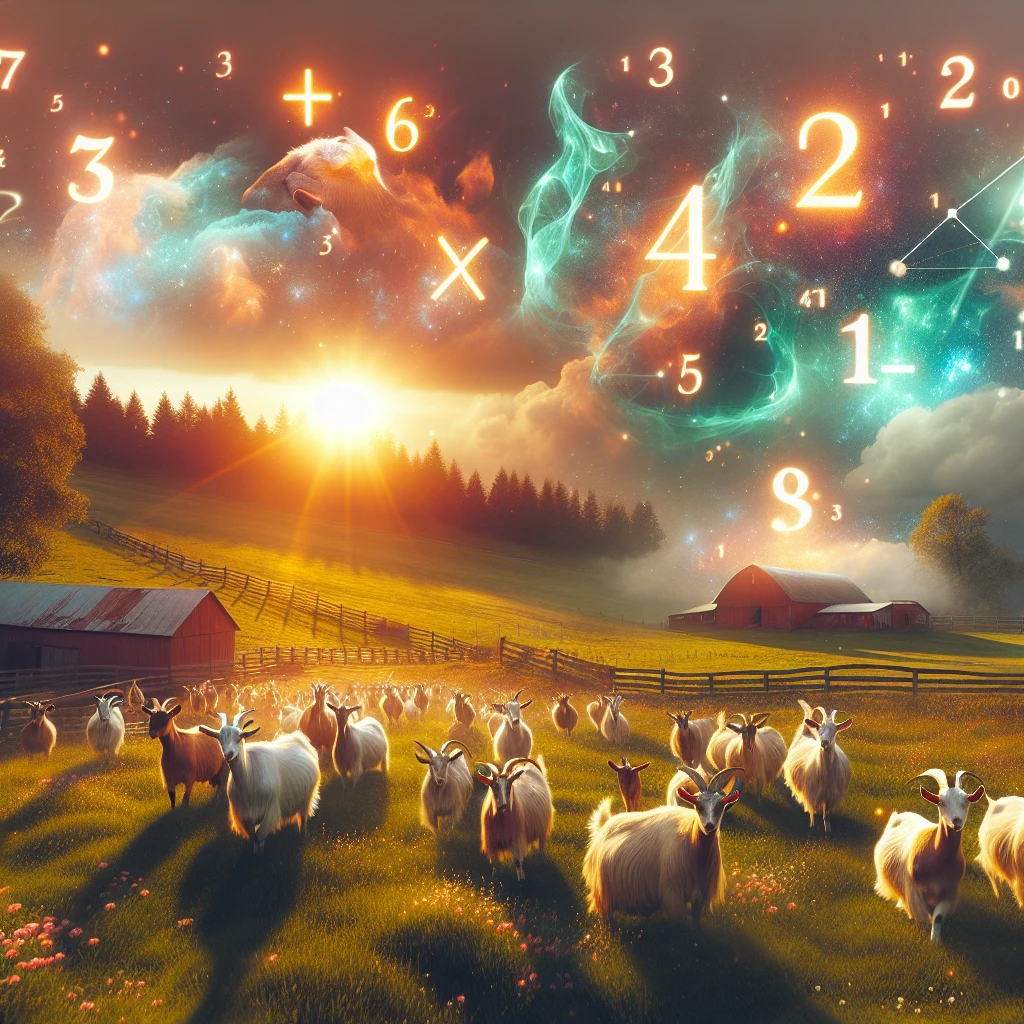
The Secret Reality of Goat Maths
Ever wondered how a harmless weekend trip to a local livestock show ends up costing you half your yard space because of goat maths? Goat maths is a highly contagious, completely illogical phenomenon that defies the very laws of traditional accounting. I first witnessed this firsthand with my buddy Ivan, who lives out near the Carpathian Mountains in Ukraine. He called me up one Tuesday swearing he was only going to buy two small Nigerian Dwarf wethers to keep the stubborn brush down behind his wooden barn. “Just two,” he promised me, insisting it was a purely practical, low-maintenance decision. By the end of the year, those two had somehow turned into a sprawling, chaotic herd of thirteen. He did not even know how it happened. First, he bought a friendly companion because one looked sad, then he adopted a rescue from a neighboring village, and suddenly he was buying purebred does to start a milking line. That is the sheer magic and chaos of this concept.
The truth is, this isn’t just about poor counting skills or a lack of self-control. It is an entirely different system of logic used by hobbyists, homesteaders, and farmers alike to justify the rapid and sudden expansion of their herds. The core thesis here is simple: once you bring one of these highly intelligent, chaotic, lovable creatures onto your property, the traditional base-10 numerical system ceases to function. It is replaced entirely by an emotional calculation where having more animals just makes flawless financial and logical sense in your head.
Why The Equation Always Equals More
To really grasp why this happens, you need to deeply understand the underlying mechanics of livestock acquisition. You start with the perfectly logical premise that caprines are highly social herd animals. You cannot physically or ethically just have one. If you have one, it gets severely depressed, screams all night for a friend, and will inevitably try to break into your house to hang out with your dog. So, logically, you must have two. But what happens if one of those two gets sick or passes away? The remaining one will be lonely again. So you need a third just as an insurance policy. That is the baseline of goat maths. It is a cascading series of rationalizations that lead to a very full barn and an empty wallet.
You also begin calculating the hypothetical “return on investment.” You think about the rich raw milk, the artisan cheese you could make, the natural lawn mowing services, and the incredibly nutrient-dense fertilizer for your garden. Every new addition seems to pay for itself in hypothetical future savings.
| Scenario | Regular Math | Goat Math Reality |
|---|---|---|
| Buying a companion | 1 + 1 = 2 | 1 + 1 = 3 (Because a trio is safer and prevents bullying) |
| Spring Kidding Season | 2 does have twins = 4 babies | 2 does have twins, you keep the babies, and buy a new buck for genetic diversity = 7 |
| Selling an animal | 5 – 1 = 4 | Sell one, use the cash to immediately purchase three rare-breed miniatures = 7 |
The massive value in recognizing this early is that it saves you incredible headaches later. If you know you are prone to this logic, you build a fence for fifteen animals instead of two right from the start.
Here are the absolute, unbreakable rules that govern this phenomenon:
- The Rule of Infinite Companions: No herd member can ever be left without a minimum of two best friends of the exact same size and temperament.
- The Cute Multiplier Factor: If a baby is under ten pounds and wears a custom-knitted sweater, it effectively counts as zero animals against your total herd limit.
- The Free-Space Vacuum: Any empty space in a newly constructed barn will mathematically attract a new rescue animal within 30 days.
- The Fencing Fallacy: The belief that if your fence holds three animals, it can magically hold twelve without requiring a massive structural upgrade.
The Deep Roots of Agricultural Additions
Origins
Humans have been domesticating these brilliant creatures for roughly 10,000 years, starting in the rugged Zagros Mountains of the Middle East. Back then, wealth was determined strictly by the absolute size of your herd. Early nomadic pastoralists didn’t use digital spreadsheets or budget apps; they used raw survival instincts. The more you had, the higher your chances of surviving brutal, harsh winters and unpredictable famines. This ancient survival mechanism is literally hardwired into our human DNA. When we look at an empty green pasture today, our paleolithic brain hits the panic button and demands we fill it with grazing livestock. That is where the psychological compulsion originally stems from. You aren’t just hoarding farm pets; you are answering a millennia-old genetic calling to secure your immediate environment and resources.
Evolution
As societies slowly evolved and moved toward currency-based agricultural economies, the absolute necessity of keeping massive, sprawling herds for basic survival began to wane. However, the deep emotional attachment to these animals did not disappear. During the agricultural revolutions of the 18th and 19th centuries, highly specialized selective breeding became a massive trend across Europe and the Americas. Farmers started keeping specific, distinct breeds for rich milk, others purely for meat, and others for luxurious fiber like cashmere or mohair. This hyper-specialization practically invented the modern version of our mathematical phenomenon. A farmer couldn’t just have a generic, mixed herd anymore; they suddenly needed a pure Nubian for high butterfat milk, an Angora for wool production, and a heavy Boer for the local livestock show. The rationale shifted seamlessly from pure survival to optimized utility and aesthetic preference.
Modern state
Fast forward to the year 2026, and the landscape has completely shifted into the passionate hobbyist realm. With the explosion of remote work and the massive neo-homesteading movement, hundreds of thousands of people have moved out to rural areas seeking a simpler, earth-connected life. Social media platforms are constantly flooded with highly viral videos of baby animals bouncing off hay bales. This digital exposure has utterly supercharged the equation. Today, you don’t even need to physically go to a local auction to acquire more; you just scroll through a localized online marketplace, fall madly in love with a pixelated photo, and suddenly you are driving three hours on a rainy Sunday morning to pick up a rescued wether. The modern state of this math is fueled entirely by dopamine loops, seamless digital connectivity, and the universal, deeply ingrained human desire to nurture living things.
The Science Behind the Growing Herd
The Psychology of Herd Accumulation
It is incredibly easy to joke about, but there is actual, documented neurological science driving this exact behavior. Neurologically speaking, acquiring a new, cute animal triggers a massive, overwhelming release of dopamine and oxytocin in the human brain—the exact same potent chemicals responsible for maternal bonding and intense happiness. When modern homesteaders experience the high stress of daily corporate or economic life, their brain actively seeks out these specific neurotransmitters for relief. Caring for an animal, especially one as highly interactive, vocal, and affectionate as a caprine, provides a highly reliable neurochemical reward. Furthermore, the “sunk cost fallacy” plays a spectacularly huge role in your accounting. You have already spent thousands of dollars on a predator-proof woven wire fence, an automatic heated waterer, and a massive cedar shelter. The brain smoothly rationalizes that the marginal cost of adding just one more animal is practically zero, completely ignoring the cumulative, long-term cost of premium feed and emergency veterinary care over the next decade.
The Genetics and Breeding Multiplier
Beyond human psychology, the raw biological machinery of the animals themselves absolutely forces the math upon you. Caprine reproduction is incredibly, almost terrifyingly efficient. A healthy adult doe has a relatively short gestation period of just about 150 days. Unlike cows, which typically have single calves, these animals are highly prone to multiple births. Twins are the baseline standard, triplets are incredibly common, and quads are not unheard of in well-managed herds. Their digestive biology—specifically their highly efficient four-chambered stomachs (rumen, reticulum, omasum, and abomasum)—allows them to turn completely useless brush and weeds into high-quality calories, tricking the farmer into thinking feeding them is essentially free.
Here are the core scientific facts that practically guarantee your herd will mathematically multiply:
- Polyestrous cycles: Many popular miniature breeds, especially Nigerian Dwarfs, can cycle and breed year-round rather than being restricted to just the traditional fall season.
- Hyper-fertility rates: A single, highly active buck can successfully cover and impregnate up to fifty does in a single breeding season, meaning population control requires incredibly strict physical separation.
- Herd hierarchy dynamics: Removing or adding an animal dramatically disrupts the entire established social structure, often requiring the addition of another specific animal of a certain temperament to restore peace.
- Rapid sexual maturity: Doelings can occasionally reach full sexual maturity as early as four to six months of age, meaning accidental early breeding can exponentially increase your numbers if you aren’t paying strict attention.
The 7-Day Strategy to Survive the Multiplication
If you are seriously planning to enter the wonderful, chaotic world of livestock keeping, you absolutely need a rock-solid, actionable plan to manage the inevitable expansion. Here is your robust seven-day preparation protocol.
Day 1: The Initial Assessment
Sit down with a cup of coffee and look critically at your actual physical acreage. Experts strongly recommend a minimum of 250 square feet of dedicated pasture per animal, but significantly more is always better for parasite management. Map out your property boundaries and identify exactly where the heaviest, most nutritious brush is located. Calculate the absolute maximum number of animals your land can support without completely degrading the topsoil, then subtract five. That final number is your actual, hard limit.
Day 2: Budgeting for the Invisible Herd
You must budget not for the two starter animals you plan to buy, but for the six you will inevitably end up with by next spring. Calculate the monthly costs of high-quality orchard grass hay, specialized loose minerals (heavy in copper), baking soda for rumen health, and specialized pelleted feed for nursing mothers. Create an iron-clad emergency veterinary fund strictly for surprise auction purchases or midnight emergencies.
Day 3: Fencing Fortification
These creatures are notoriously brilliant, athletic escape artists. If a fence cannot effectively hold water, it cannot hold them. Spend this entire day installing heavy-duty, tightly woven wire fencing with four-by-four inch squares so they cannot get their horned heads stuck. Add a high-voltage strand of electric wire at the absolute top and bottom to stop them from climbing, leaning, and digging under.
Day 4: Nutritional Planning
Different specific stages of life require vastly different feeding protocols. Wethers (castrated males) need strict 2:1 calcium-to-phosphorus ratios to prevent highly lethal urinary calculi. Pregnant does need massive amounts of extra calcium and high energy in late gestation to prevent pregnancy toxemia. Map out a comprehensive feed chart and source reliable local agricultural suppliers who can deliver in bulk.
Day 5: Veterinary Preparedness
Find a highly specialized large-animal livestock vet well before you bring anyone home. Build a comprehensive, fully stocked medical kit containing specialized probiotics, oral electrolytes, activated charcoal for toxic plant ingestion, targeted dewormers, and a digital rectal thermometer. Knowing exactly how to take their temperature is your critical first line of defense against fast-moving illnesses like pneumonia.
Day 6: The Social Dynamics Strategy
Plan your exact herd composition incredibly carefully. A mix of purely wethers is incredibly peaceful, quiet, and cheap to maintain. A herd of dairy does is highly productive but requires daily, exhausting milking routines. Keeping an intact buck requires an entirely separate, heavily fortified, and wind-protected area because bucks in full rut are aggressively strong, incredibly smelly, and relentless. Decide exactly what intense social structure you are genuinely willing to manage.
Day 7: Managing the Emotional Attachment
Prepare yourself mentally and emotionally for the harsh reality of farming. You will occasionally lose animals to illness, you will face massive, unexpected vet bills, and you will fall madly in love with a stubborn creature that insists on standing directly on top of your freshly washed car. Accept right now that the mathematics of keeping them is fundamentally flawed, but the immense joy they bring makes every irrational calculation totally worth it.
Myths and Reality in Livestock Accounting
Myth: You only need one goat to effectively keep the grass and weeds down in your backyard.
Reality: They are strictly and biologically herd animals. A solitary caprine will experience severe clinical depression, intense stress, and will scream endlessly until it loses its voice. You always need at least two, preferably three.
Myth: They possess iron stomachs and will eagerly eat anything, including tin cans, garbage, and old clothing.
Reality: They are actually incredibly picky browsers, not grazers like sheep or cows. They massively prefer broadleaf weeds, woody brush, and high-hanging tree leaves. They naturally investigate strange things with their prehensile lips, which is exactly where the tin can myth originated, but their complex digestive systems are actually highly sensitive to sudden dietary changes.
Myth: Keeping a few dairy does is a brilliantly cheap way to get totally free milk for your family.
Reality: By the time you rigorously factor in the high cost of premium protein alfalfa, heavy-duty fencing, stainless steel milking equipment, and routine veterinary care, that “free” gallon of fresh milk is mathematically the most expensive liquid sitting in your refrigerator.
Myth: Small, miniature breeds stay perfectly small, docile, and are as easy to handle as a golden retriever.
Reality: Even miniature breeds can quickly reach 80 dense pounds. While visibly smaller than a standard 200-pound dairy breed, they still possess immense physical strength, stubbornness, and the sheer momentum to easily knock you flat on your back if they aggressively want the morning grain bucket.
Frequently Asked Questions
How many should I realistically start with?
Always start with exactly two. This perfectly satisfies their deep herd instinct without completely overwhelming you as a novice beginner learning the ropes.
What is the absolute best breed for beginners?
Nigerian Dwarfs or Pygmy breeds are universally fantastic due to their much smaller physical size, highly manageable and friendly personalities, and incredibly rich, high-butterfat milk.
Can they peacefully live in the same pasture with sheep?
Yes, but they strictly require entirely different copper levels in their daily loose minerals. What is perfectly healthy for a caprine can be highly toxic and fatal to a sheep.
Do they actually smell bad all the time?
Only intact adult males (bucks) smell genuinely terrible, especially during the fall breeding season when they urinate on their own faces. Females (does) and castrated males (wethers) have practically no foul odor at all.
How hard is it to keep them safely contained?
Extremely hard. You absolutely need heavy-duty, tightened woven wire fencing. Flimsy chain link or basic wooden horizontal rails will be utterly destroyed, pushed through, or effortlessly climbed over within days.
Do they explicitly need a fully enclosed barn?
They absolutely despise the rain and wet snow. They fiercely need a solid, completely draft-free, three-sided shelter at the very least to stay dry, warm, and protected from high winds.
Is goat maths a genuinely real financial problem?
It absolutely can be! If you don’t meticulously track your monthly feed consumption and routine vet expenses, the creeping, steady expansion of your hungry herd can quickly and silently drain a household budget.
As you boldly embark on this beautifully chaotic and highly rewarding journey, remember that fully understanding goat maths is more than half the battle. You are now fully equipped with the deep psychological insights, the rich historical context, and a rock-solid, foolproof seven-day plan to expertly handle the inevitable expansion of your green pasture. Embrace the beautiful madness, heavily fortify your perimeter fences, and thoroughly enjoy the agricultural adventure. If you are finally ready to start planning your perfect backyard homestead setup, start reaching out to reputable local breeders today and aggressively prepare your budget for the inevitable multiplication!