
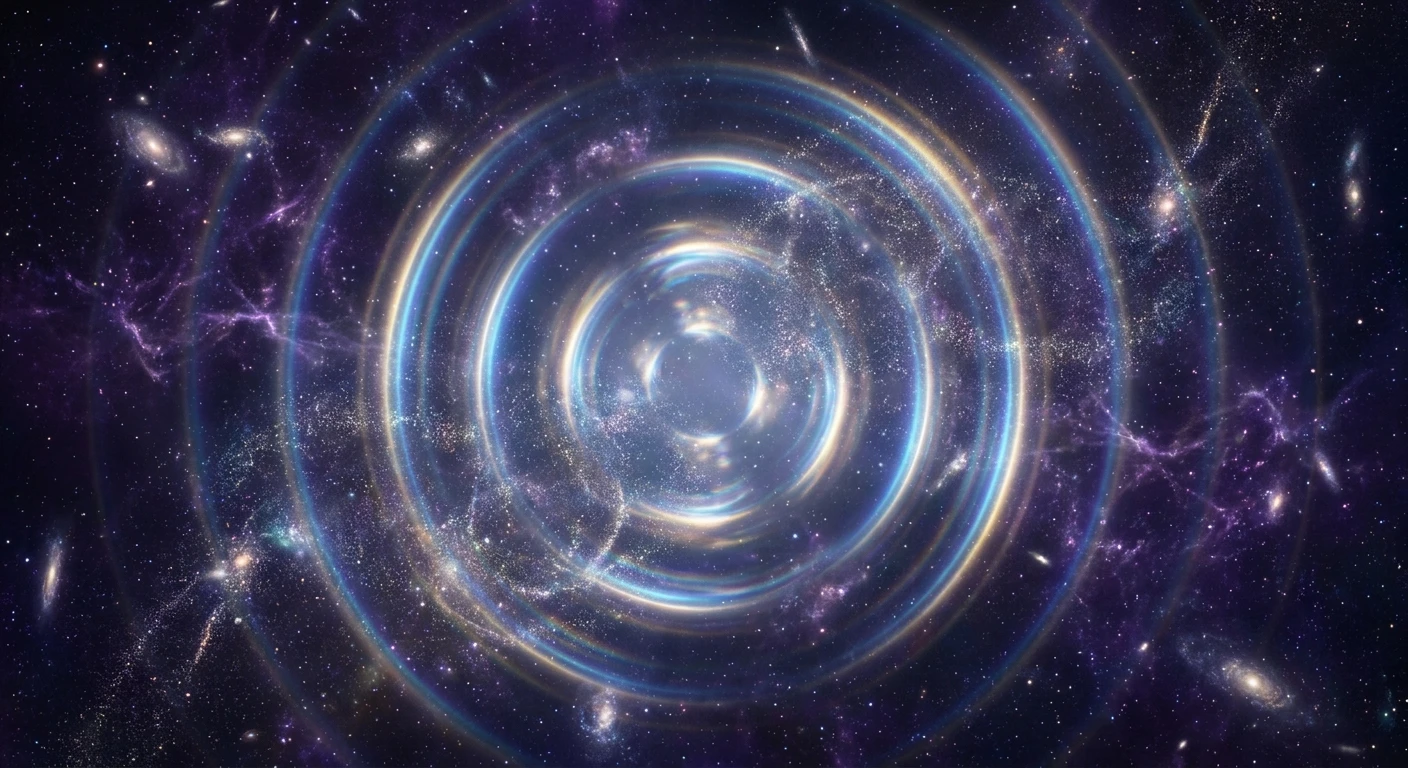
The Marvel of Dust Echoes Explained
Did you ever look up at the night sky and wonder if you could actually see into the past, because observing dust echoes lets you do exactly that. Seriously, I was texting my buddy about this late last night, and we completely blew our own minds thinking about how the universe plays tricks with time. My deep fascination with all of this started a few years ago back home in Ukraine. I was staying in a tiny, drafty wooden cabin deep in the Carpathian mountains during a total winter blackout. We had absolutely no power, no streetlights glowing in the distance, and my phone was completely dead. Stepping outside into the freezing, pitch-black silence, the sky looked like an endless ceiling painted with glowing milk. It got me thinking about how starlight travels across completely unimaginable distances and bounces off invisible cosmic clouds just to reach our retinas. That is the fundamental premise of a dust echo. It happens when a massive, blinding flash of light, like a dying star exploding into a supernova, blasts outward and eventually hits a thick, sprawling cloud of interstellar matter. The light bounces off that dense cloud and redirects its path toward Earth. Because this scattered light has to travel a much longer, angled path than the direct light from the initial explosion, it arrives months, years, or even decades later. It is literally a visual playback of cosmic history, serving as a natural time machine that gives astronomers a way to view a single explosive event from multiple angles and different timeframes. We are essentially watching a slow-motion replay of a star’s death, and that thought completely floors me every single time.
Let me break down exactly why this matters and how it all works in practice, because the mechanics are wildly cool. When you think about the massive, multi-billion-dollar telescopes floating out there in the freezing void of space, you quickly realize they are fundamentally just giant light-catching buckets waiting to trap these faint historical reflections. Understanding these reflections gives us a massive edge in mapping the universe. The core value proposition here is twofold: first, it allows us to analyze the exact chemical makeup of invisible space clouds, and second, it helps us reconstruct the original explosion in stunning 3D. A great example of this is the famous V838 Monocerotis event. Back in the early 2000s, this star flashed brilliantly, and over the following years, Hubble captured glowing, expanding rings of light around it. People thought the star was throwing off shells of gas, but it was just light hitting existing clouds. Another brilliant example is Supernova 1987A, where scientists used delayed reflections to map out the complicated rings of material surrounding the dead star.
| Echo Type | Primary Cause | Visual Effect |
|---|---|---|
| Infrared Echo | Dust particles heating up and re-radiating energy | Bright thermal glowing rings |
| Optical Echo | Visible light directly scattering off dust grains | Expanding concentric light rings |
| X-Ray Echo | High-energy bursts reflecting off molecular clouds | Faint, high-frequency halos |
To really grasp how professionals track these phenomena, you have to look at their process. It is completely methodical:
- First, scientists have to catch the initial bright flash of the supernova or stellar flare. This sets the baseline timer for the whole event.
- Second, they continuously monitor the dark space around the star for years, waiting for the delayed light to finally hit the surrounding clouds and bounce our way.
- Finally, they use advanced geometry and spectroscopy to calculate the exact distance, shape, and thickness of the clouds based on the time delay of the reflection.
The Humble Origins of Starlight Tracking
If we look back at how we even figured this out, the history is super fascinating. Back in the early 20th century, astronomers were still relying on fragile glass photographic plates to capture the night sky. They would stare through massive, heavy brass telescopes and expose these plates for hours just to capture a tiny smudge of light. When they first noticed faint rings of light expanding around novae, they completely misunderstood the physics. They initially thought they were watching physical gas clouds blowing outward at speeds faster than light, which completely broke all known laws of physics at the time. It took a while for some smart minds to realize it was just an optical illusion created by light bouncing off stationary dust.
The Evolution of Deep Space Imaging
As the decades rolled on, our equipment got dramatically better. The launch of the Hubble Space Telescope completely changed the game. Suddenly, we were no longer peering through Earth’s blurry, messy atmosphere. We had a crystal-clear view of the cosmos. Hubble provided those iconic, jaw-dropping images of light expanding like ripples in a cosmic pond. It was no longer just a bunch of math on a chalkboard; it was a stunning visual reality that anyone could look at and appreciate. The sheer resolution allowed astronomers to track the reflections month by month, creating those incredible time-lapse videos that look absolutely unreal.
The Modern State of Cosmic Mapping
Fast forward to where we are now. Honestly, living in 2026, the technology at our disposal is basically science fiction made real. The James Webb Space Telescope has completely revolutionized our understanding of these phenomena because it sees in infrared. It can peer straight through the thickest, darkest clouds of the universe and watch the dust heat up and glow. Now that it is 2026, the sheer volume of data we process every single day is staggering. We are not just looking at pretty pictures anymore; we are actively mapping the 3D structure of the Milky Way using these bouncing light rays as our cosmic sonar system.
The Physics of Light Delay
You might be wondering about the actual mechanics making all this possible. It all comes down to simple geometry and the absolute speed limit of the universe. When a star explodes, the direct flash travels straight to Earth. But the light heading out sideways hits a cloud, bounces, and then heads toward us. Think of a triangle. The straight line is always shorter than the path that goes out to a corner and then comes back. That extra distance means the bounced light arrives much later. It is a massive cosmic delay pedal, like an echo in a giant canyon, but instead of sound waves taking seconds, it is light waves taking years.
Spectroscopy and Dust Composition
The other wild part of this is what the clouds are actually made of. We call it “dust,” but do not think of the stuff under your couch. This is highly complex interstellar material. By analyzing the bouncing light, we can tear apart its spectrum and figure out the exact chemical recipe of the cosmos. Scientists look at the fingerprints left in the light to see what the blast is hitting. To make this easier to digest, here are some wild facts about the whole process:
- Interstellar dust grains are impossibly tiny, typically measuring less than a single micrometer across, much smaller than sand.
- The particles are primarily composed of carbon-rich compounds, silicates, and frozen water ice floating in a complete vacuum.
- The specific angle at which the light hits the grain dictates how brightly the reflection will appear to our telescopes on Earth.
- Because blue light scatters much more easily than red light, these reflections often have a distinctly bluish, ghostly tint to them.
Day 1: Grasping the Cosmic Scale
If you genuinely want to wrap your head around this stuff, I suggest following a little seven-day mental roadmap. On the first day, just spend some time looking up the actual distances involved. Realize that light takes over four years just to reach our nearest neighboring star. Once you understand the agonizing slowness of the speed of light on a galactic scale, the idea of an echo taking decades to reach us suddenly makes perfect sense. It requires a massive perspective shift.
Day 2: Exploring Famous Supernovae
For day two, I highly recommend looking up the historical records of massive star explosions. Search for the supernova of 1054, which created the Crab Nebula. Read about how ancient astronomers documented these sudden bright flashes in the sky. Understanding the sheer violence of these initial explosions gives you the necessary context for the faint reflections that follow thousands of years later.
Day 3: Mastering Basic Astronomy Tools
By day three, you should absolutely download a free star-mapping app on your phone. Apps like Stellarium are fantastic. Go outside at night, point your phone at the sky, and locate the constellations where famous explosions occurred. Getting a physical, directional sense of where these events are happening in your own local sky connects the crazy abstract science to your immediate reality.
Day 4: Learning About Stardust Composition
Spend day four reading about what makes up the universe. I mentioned silicates and carbon earlier, but digging into how stars forge these heavy elements in their cores and then violently sneeze them out into the void is fascinating. The dust causing the reflection was literally made inside a completely different star billions of years ago. It is recycled stellar guts.
Day 5: Understanding Light Spectrums
On the fifth day, look into spectroscopy. You do not need a physics degree, just watch a few basic videos on how prisms break light into rainbows. Understand that missing lines in that rainbow tell us exactly what chemicals the light passed through. This is the exact method researchers use to know what the space clouds are made of without ever going there.
Day 6: Virtual Telescope Tours
Day six is strictly for eye candy. Go to the official NASA or ESA websites and look at the raw image archives from Hubble and Webb. Search specifically for V838 Monocerotis. Watch the time-lapse animations of the light expanding over the years. Seeing the actual photographic evidence of the reflection moving outward is an experience you will not forget.
Day 7: Joining the Amateur Astronomy Community
Finally, on day seven, connect with other people who love this stuff. Find a local astronomy club or join an active Reddit community. You would be amazed at how many passionate hobbyists are tracking smaller novae from their own backyards. Having conversations with people who spend their weekends staring at the sky keeps the fascination alive and gives you an awesome new hobby.
Now, let me clear up some major misconceptions, because the internet is full of bad science. Myth: Dust echoes are massive rings of actual gas physically exploding outward faster than light. Reality: The gas and matter are completely stationary; it is just a moving wave of light sweeping across them, creating an optical illusion of superluminal speed. Myth: You can step into your backyard and easily see these reflections with your naked eye. Reality: These reflections are incredibly faint and require massive, sensitive telescopes and long-exposure photography to detect. Myth: Space is a completely empty vacuum. Reality: Space is incredibly dusty and full of thick molecular clouds, which is the only reason these reflections can happen in the first place. Myth: These events are totally random and impossible to predict. Reality: While the initial supernova is hard to predict, once it happens, astronomers know exactly where and when to look for the delayed reflections.
What exactly causes the reflection?
It is strictly light bouncing off tiny grains of carbon and silicate floating in interstellar clouds.
How long do these phenomena last?
They can remain visible to our telescopes for decades, depending on the thickness and sheer size of the cloud.
Do they pose any danger to Earth?
Absolutely not. They happen thousands of light-years away and are just harmless photons reaching our lenses.
Can amateur astronomers photograph them?
It is extremely difficult, but hobbyists with highly advanced astrophotography rigs and extreme patience have captured the brightest ones.
Why are they mostly circular?
We are viewing a spherical expansion of light interacting with a cloud, which translates as expanding 2D rings from our viewpoint.
How does infrared technology help?
Infrared detects the heat of the dust grains absorbing the light, cutting completely through visual obscurations.
What is the most famous example?
V838 Monocerotis remains the absolute gold standard due to the breathtaking Hubble time-lapse images.
Are there other types of light echoes?
Yes, black holes consuming matter can also create X-ray reflections off nearby accretion disks.
I honestly think looking up at the night sky changes you once you understand what is happening behind the curtain. The universe is not just static dots of white; it is a dynamic, echoing chamber of history unfolding right before our lenses. Now that you know exactly what causes these incredible illusions, grab a star app, head outside tonight, and start exploring the dark patches between the stars for yourself!