
If you live in a big city, local media can feel like background noise until something breaks. A storm. A rail mess. A council scandal. A bushfire. Then suddenly you want the one place that knows the roads, the names, the river levels and the difference between a broad regional headline and the street-level reality under it.
And look, this is not really a story about one station in the abstract. It is a story about what happens when local broadcasting still behaves like local broadcasting. Not like a content farm. Not like a national newsroom lazily changing a suburb name in a template. Something much closer to a public service stitched into the place it serves.
That’s why “ABC Far North” means more than a logo or a frequency. For a lot of people across Cairns and the wider region, it means a voice that sounds like it knows where you are. That can sound like a small thing. It isn’t.
So what is ABC Far North, exactly?
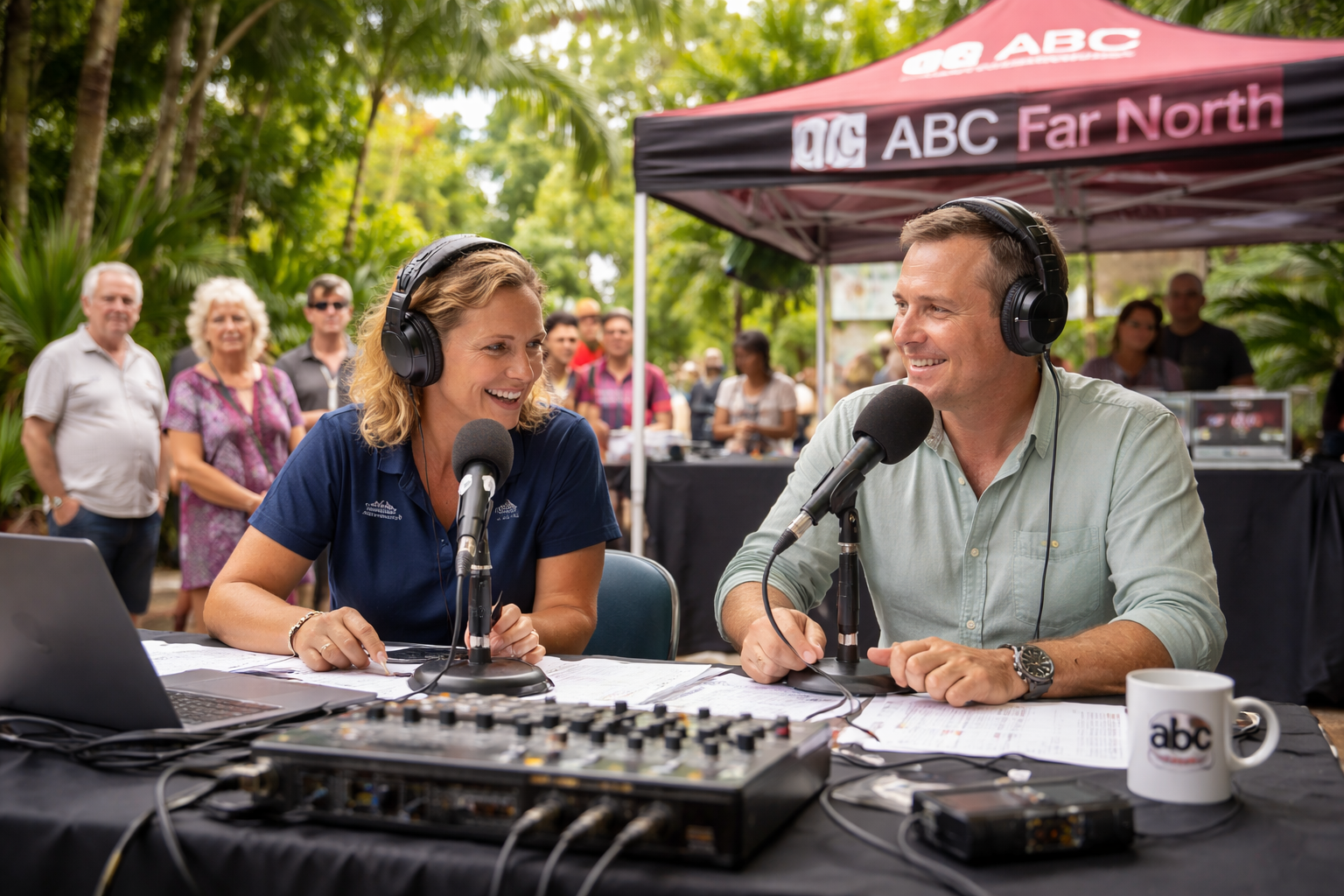
At the simplest level, ABC Far North is the ABC’s local service for Far North Queensland. Its online hub pulls together local news, features, audio and weather for communities including places such as Atherton, Cairns City and Cooktown. On the audio side, it runs as a local ABC radio service through ABC listen and on air, with a clear local program shape rather than just a generic Queensland feed.
That part matters. Because “local” can mean very different things depending on the outlet. Sometimes it means a national organisation with a token local wrapper. Here, it means actual daily programming, actual presenters attached to the region, actual local bulletins and a stream of stories that would make no sense to people elsewhere — which is usually the best sign that something is genuinely local.
Weekday mornings are fronted by Charlie McKillop. Saturdays have Amanda Cranston. Local news is updated at 6:30am on weekdays. Saturday sport has Bluey Forsyth on Grandstand. Even that lineup tells you something. This is not a tiny afterthought service. It is a functioning local schedule with recognisable voices, recurring habits and enough continuity that listeners can build routines around it.
| Part of ABC Far North | What it does | Why locals care |
|---|---|---|
| Local news site | Runs local stories, weather, interviews and region-specific updates | It reflects the actual concerns of Far North Queensland, not just statewide news |
| Far North Breakfast | Starts the day with local news, weather and conversation | It gives the region a daily shared starting point |
| Weekday local news bulletin | Updated at 6:30am | People can get a clean local snapshot before the day properly begins |
| Saturday Breakfast and Grandstand | Keeps local community, weekend culture and sport in the mix | It makes the service feel like part of life, not just part of crisis |
Why local media feels different in the Far North
Far North Queensland is not just “Queensland, but further up.” It has its own tempo. Its own anxieties. Its own kinds of practical knowledge. A city newsroom down south might understand weather warnings in a broad sense. But Far North listeners often want something more specific than that. They want to know how the road to Port Douglas is looking. Whether supply chains are tightening. What local growers are saying. Whether the rain is going to sit on the ranges or shift. Whether a flood watch is abstract or serious. Whether the issue is Cairns, the Tablelands, the Cape or the Gulf.
That is where ABC Far North earns its keep. It turns regional life into something legible at human scale.
And that’s the thing city audiences sometimes miss. Local journalism is not only about shrinking the map. It is about sharpening it. The more geographically stretched a community is, the more important it becomes to have someone sorting what matters where. Not all northern stories are the same story. Good local media knows that.
- It helps listeners sort urgent information from general noise.
- It gives context that outside coverage often misses.
- It connects scattered communities through a shared local conversation.
That last part is easy to underestimate. Far North Queensland is not one identical community. It is many places, many local economies, many identities. A station like ABC Far North works partly because it keeps those places in conversation with each other.
It is not only about disasters, but disasters reveal its value fast
Whenever people talk about local ABC services, the emergency angle comes up first. Fair enough. It should. Emergency broadcasting is one of the clearest arguments for keeping strong local public media alive. And in Far North Queensland, that argument is not theoretical. Flood watches, cyclones, road closures, supply strain and storm systems are not rare events that sit politely in the history books. They remain part of the region’s lived reality.
ABC Emergency pages still route warnings through local service names, including ABC Far North. That may sound administrative, but it matters. It shows the ABC still treats local broadcasting as part of the emergency information chain, not as decorative regional branding on top of national alert language.
In a place like the Far North, that role is crucial because the weather story is never just the weather story. It becomes a road story, a community story, a supermarket story, a tourism story, a school story, a freight story and sometimes a survival story. Listeners do not just need a weather map. They need interpretation anchored in place.
And yet what is striking about ABC Far North is that it does not only exist for the dramatic days. A lot of its real social value comes from the quieter days. The days when the lead story is not a disaster, but something deeply local and deeply telling: a campaign to save a Cairns tree, a warning from truckies about fuel supply, a cassowary family on a Mission Beach cocoa farm, or practical advice about mould in wet-season homes. That mix matters. It proves the station is not just a siren. It is part of the region’s ordinary civic life.
The story list tells you everything
One of the best ways to understand a local outlet is simply to look at what it chooses to place in front of people. ABC Far North’s recent story mix says a lot. One minute you have calls for calm at the bowser during fuel worries. The next, a “sweet start” for a cassowary family. Then a gardening figure backing a campaign to save an iconic Cairns tree. Then a practical segment on mould in Far North homes.
That is not random. That is the texture of a place.
It shows a local newsroom paying attention to the overlap between infrastructure, environment, community identity, wildlife, household life and weather. In other words, exactly the overlap that defines a lot of life in the Far North. Big-city media often separates those things into different neat content boxes. Local media in a place like this cannot afford to. Life there does not separate neatly either.
And maybe that is why listeners keep turning up. They hear a service that is not embarrassed by the everyday. It treats practical local life as newsworthy. Because it is.
| Recent story type | What it sounds like on paper | What it really says about the service |
|---|---|---|
| Fuel supply concerns | Transport and economy story | The station understands how quickly logistics becomes a local public issue |
| Cassowary family feature | Wildlife and feel-good local yarn | The station reflects the region’s environmental identity, not only hard news |
| Save the Cairns tree campaign | Community heritage and civic activism | It pays attention to local symbols and what people care enough to defend |
| Mould advice in wet season | Practical household support | It treats lived local conditions as part of public service journalism |
The presenters matter more than people admit
Local radio is still, stubbornly, a voice medium. That sounds obvious, but it’s worth saying because a lot of media analysis skips over it. People do not build trust with a station only through editorial lines or institutional reputation. They build trust through repeated exposure to voices that sound grounded, competent and local enough to make the whole service feel inhabited rather than automated.
Charlie McKillop on weekday Breakfast does not matter only because her name is on the schedule. She matters because local breakfast radio is one of the few daily media rituals left that still gives a region a shared start. Amanda Cranston on Saturday Breakfast matters because weekend local radio has a slightly different job — part current affairs, part community temperature, part cultural life. Bluey Forsyth on Saturday Grandstand matters because sport in regional Australia is not side content. It is part of social glue.
These voices make ABC Far North feel like a place rather than a feed. And that distinction is huge. Plenty of digital products deliver information. Fewer create belonging.
- Regular presenters give listeners continuity.
- Continuity builds trust faster than branding does.
- Trust is what makes people stay tuned when things get difficult or uncertain.
That is not nostalgic fluff. It is one of the operational strengths of good local radio.
ABC Far North also shows what public broadcasting is supposed to do
This is the wider social angle. ABC says it has more than 50 local newsrooms across Australia. That matters because it sets the Far North service inside a national public-service framework rather than a purely commercial one. The point of that model is not to chase only the largest audience, or only the most clickable topic, or only the cleanest advertiser-friendly mood. The point is to keep local civic information alive in places that still need it.
And Far North Queensland very obviously still needs it.
There is a tendency in media conversations to talk about local journalism as though it were a nice extra. A community garnish. Something warm and worthy, but somehow secondary to the “real” national story. ABC Far North quietly exposes how wrong that framing is. In many places, local journalism is the real story. It is the layer people need before national news makes sense. It is where policy becomes consequence. Where weather becomes disruption. Where transport becomes fuel anxiety. Where wildlife becomes road risk. Where humidity becomes mould and mould becomes everyday health and housing frustration.
That is exactly what public broadcasting should be able to do. Take the broad and make it local. Take the local and make it legible. Hold both at once.
The station’s social role is bigger than headlines
Here is something people often miss. A station like ABC Far North is not only a news provider. It is also a kind of civic meeting point. Not because everyone agrees there. They absolutely do not. But because people in the region know it exists as a common reference point.
That shared reference matters in fragmented media life. When audiences split across apps, niche creators, closed group chats and algorithmic feeds, common civic space shrinks. Local radio can still create some of it. People know where to call. They know where to text. They know the morning show. They know the local bulletin. They know the service will probably be there tomorrow, not just while a social post is trending.
That reliability is social infrastructure. And like all infrastructure, people tend to notice it most when it weakens.
For a place like Cairns and the wider Far North, that makes ABC Far North more than a broadcaster. It makes it part of the region’s public rhythm. Not the only one. Not the whole thing. But a real part of it.
And yes, it still has to compete in a changed media world
None of this means local ABC services get a free pass. They still have to be sharp, useful and reachable. They still have to work on phones, in cars, through apps and across digital habits that have changed massively. People now listen live, listen back later, stream clips, read short articles, catch a segment in the app, or just hear a piece quoted somewhere else. The service has to meet all of that.
In that sense, ABC Far North is not surviving because the old model stayed frozen. It is surviving because the local-radio DNA has been stretched across new habits. The live stream, the listen-back pages, the short-form local audio pieces and the website all matter together now.
That is another reason the service still feels relevant. It has not tried to pretend the audience lives only in front of a radio. But it also has not thrown away what made local radio valuable in the first place.
That balance is harder than it looks. Plenty of media outlets have managed digital transition by flattening their local character. ABC Far North feels more useful when it keeps the local character intact and lets the format flex around it.
FAQ
What is ABC Far North?
ABC Far North is the ABC’s local service for Far North Queensland, combining local radio, local news, weather, interviews and regional stories.
Where is ABC Far North focused?
Its current local coverage includes communities such as Atherton, Cairns City and Cooktown, along with the wider Far North Queensland region.
Who presents ABC Far North Breakfast?
Weekday Far North Breakfast is currently presented by Charlie McKillop.
When is the local news bulletin updated?
ABC Far North Local News is updated on weekdays at 6:30am.
Why does ABC Far North matter so much during emergencies?
Because local context matters in emergencies, and the service helps turn warnings into practical information people can actually use in the region.
Is ABC Far North only about hard news?
No. It also covers local culture, sport, wildlife, weather, community campaigns and practical everyday issues that define life in the Far North.
Why do local presenters matter?
Because familiar local voices build trust, continuity and a sense that the service genuinely belongs to the region it covers.
Conclusion
ABC Far North matters because it still does something a lot of media has stopped doing well: it pays sustained attention to a place. Not just when disaster hits. Not just when a story looks dramatic enough for the national homepage. Day after day. Wet season and dry season. Council issue and cassowary sighting. Fuel worry and footy. Local tree campaign and mould fix. All of it.
That is what makes the service more than a broadcaster. It becomes part of how a region understands itself. And for Far North Queensland, that is no small role. This is a place where distance, weather, environment and community life keep intersecting in ways that demand genuinely local interpretation.
So yes, ABC Far North is a radio service, a news site and part of a national public broadcaster. But it is also something simpler and more important: a familiar local point of orientation in a region where the daily map is never quite as simple as outsiders think. That is why it still matters. And why, when local media works properly, people tend to feel it in their bones long before they explain it in theory.