
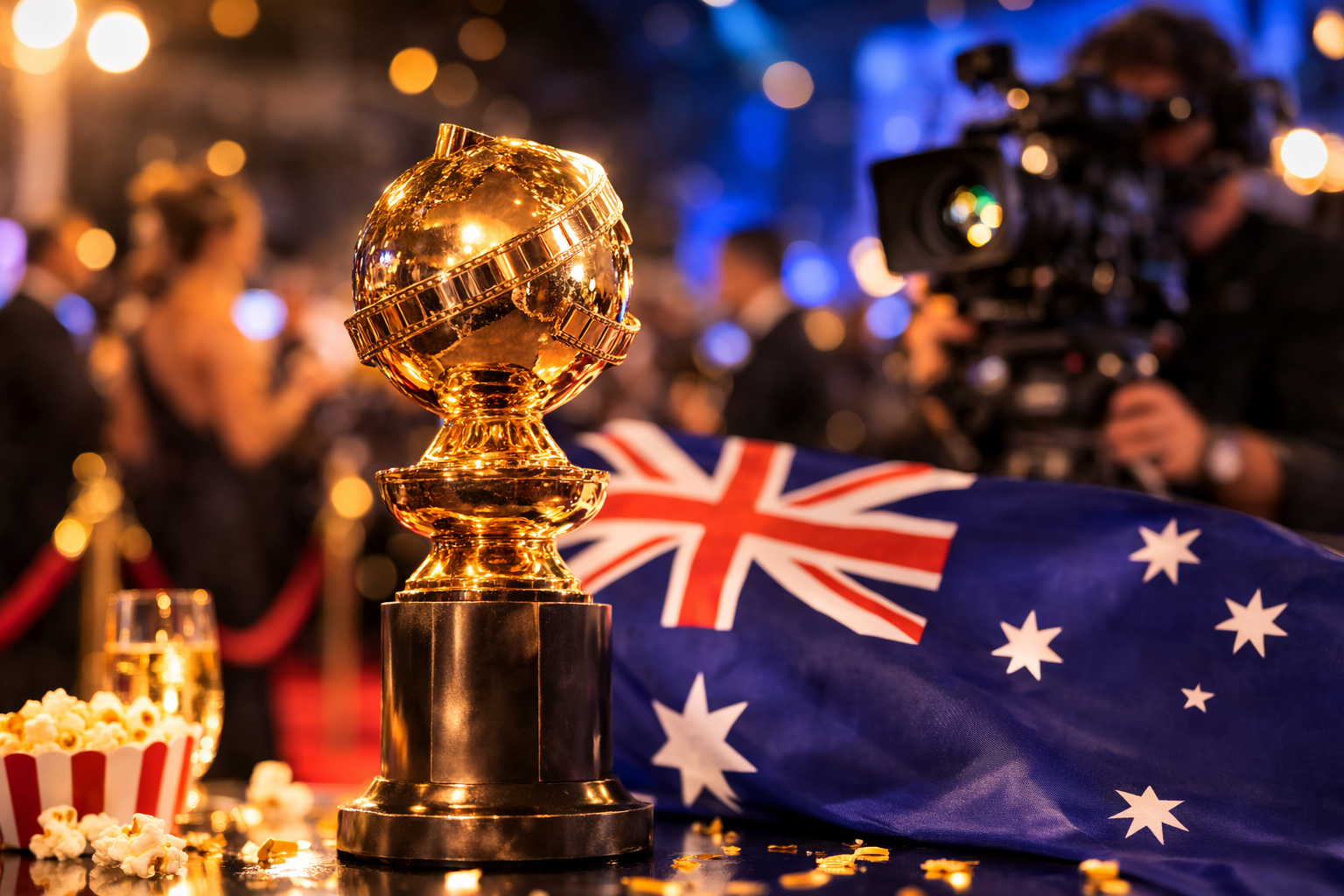
If you search “Golden Globes Australia,” you’re probably asking a very practical question first. What time is it on here? Fair. That’s always step one. Because in Australia, the Golden Globes is never really a Sunday night event. It’s a Monday thing. A weird, glamorous, coffee-fuelled Monday thing.
That’s why “Golden Globes Australia” has become its own mini-category of curiosity. Australians don’t just want the winners. They want the local times, the streaming option, the replay plan, the red-carpet workaround, the Aussie nominees to watch, and the bigger question underneath it all: why do we still care so much about an awards show happening on the other side of the world?
And honestly, it’s a good question. Because the Golden Globes has changed. The industry around it has changed. Streaming has changed. Celebrity culture has changed. But the Globes still manages to cut through here. Not always in the same way. Not always with the same prestige. But it cuts through.
That’s because for Australians, the Golden Globes is not just an award show. It’s the unofficial opening bell of international awards season. It’s the first real sign that the global entertainment year has started to take shape. It tells us what films are getting heat, what TV is carrying momentum, who might become an Oscar story, and whether any Australians are in the room with a serious shot.
The first thing Aussies always ask: when is it actually on?
Let’s start where Australians always start — not with Best Picture, but with the clock.
The latest Golden Globes ceremony, the 83rd edition, aired live from Los Angeles on Sunday 11 January 2026 U.S. time. Here in Australia, that translated to Monday 12 January. The live stream in Australia was listed at 11am AEDT, which meant the actual local viewing times shifted depending on where you were. So yes, the first Globe of the day was often geography, not cinema.
| Australian location | Local start time | What that means in real life |
|---|---|---|
| NSW / Victoria / ACT / Tasmania | 11am AEDT | A late-morning awards show, ideal for “working” with a second screen open |
| Queensland | 10am AEST | Still very watchable, especially if you’ve mastered quiet multitasking |
| South Australia | 10:30am ACDT | The classic half-hour plot twist returns, as always |
| Northern Territory | 9:30am ACST | An earlier start, more like a serious morning commitment |
| Western Australia | 8am AWST | Basically a breakfast Globes situation |
That timing matters more than it sounds. It shapes how Australians watch the event. We rarely get the glamorous evening version. We get the “have I got time before lunch?” version. We get speeches with coffee. We get red carpet clips during commutes. We get a very Australian mix of entertainment obsession and weekday practicality.
And maybe that’s part of the charm. We don’t receive the Golden Globes in its natural habitat. We adapt it. We fold it into our day. That’s a very Australian media habit in general, actually — taking something imported and making it fit our own rhythm.
Where Australians watched it this time
The 2026 ceremony streamed on Paramount+ in Australia. That’s important because the local home of the Globes has shifted around over the years, and audiences have learned not to assume the platform will be the same every season. One year it feels easy, the next year people are suddenly asking whether it’s on free-to-air, a streamer, or hidden behind some delayed replay arrangement that sounds simple until you try to find it.
That uncertainty is part of the modern awards-show experience. The ceremony itself may be glamorous, but the local watch plan can feel weirdly administrative. People want to know not just when it’s on, but how much effort will be required to be the kind of person who watches it live.
In Australia, that matters because awards shows compete with ordinary life more harshly than they do in the U.S. They’re not an evening destination here. They’re an interruption. So the easier the local broadcast setup is, the more likely the Globes remains culturally present rather than turning into something most people only meet through TikTok highlights and next-day winner lists.
- Australians want live access, not just delayed clips.
- They want local timing explained clearly, because time zones still cause chaos.
- And they want a simple platform answer, because no one enjoys awards-show scavenger hunts.
That’s why “where to watch in Australia” has become almost as important as “who won.” It’s not glamorous, but it’s real.
The Golden Globes still matter here because they’re the first big mood-setter
There’s always a temptation to ask whether the Golden Globes matters as much as it used to. Fair question. The answer is probably no — at least not in the exact old way. The show has had credibility problems, reform problems, relevance questions, and all the usual modern-awards-show problems that arrive once audiences stop treating these nights as unquestioned cultural monuments.
But here’s the thing. In Australia, the Globes still matters because it is the first big awards-season mood-setter. That role is very hard to replace.
The ceremony still tells viewers which films suddenly feel hot, which TV titles are carrying momentum, which performances are moving from “critics liked it” into “everyone now has to talk about it,” and which campaigns are either surging or wobbling. It’s not the final word, but it’s a loud early word. And early words travel.
That’s especially true in Australia because our mainstream entertainment conversation still relies heavily on imported awards-season cues. We do have our own industry, our own prizes and our own stars, obviously. But the global screen conversation still rolls heavily through Los Angeles, London, Cannes, Venice, the Oscars, the Emmys, the BAFTAs and, yes, the Golden Globes.
So while the Globes might not feel as definitive as it once did, it still works like the first major flare in the sky. People notice. Publicists notice. streamers notice. Entertainment editors definitely notice. And once it’s happened, the rest of the season starts to feel real.
And then there’s the Australian question: did we have skin in the game?
This is the bit that makes the Globes especially sticky here. Australians always care more when there is a local angle, and this year there absolutely was.
Rose Byrne won Best Performance by a Female Actor in a Motion Picture – Musical or Comedy for If I Had Legs I’d Kick You. That mattered, and not just as a neat little national-pride moment. Byrne has long had that fascinating Australian position where everyone knows she’s excellent, everyone knows she’s worked steadily and smartly for years, and yet each major awards breakthrough still feels like a fresh reminder that she is more formidable than the global celebrity machinery has sometimes acknowledged.
Her win gave Australian viewers a reason to watch the Globes not as distant Hollywood theatre, but as something with real local emotional charge. It also helped shift the usual Australian awards-season mood from hopeful nomination-watching into something better: actual victory.
Then there was Jacob Elordi, nominated for supporting actor for Frankenstein. Even when Australians roll their eyes at the idea of “claiming” anyone who has gone fully international, we still do it. Politely, casually, aggressively — whatever the moment requires. Elordi’s rise has become one of the more interesting Australian screen stories of the past few years because he manages to feel both recognisably Australian and very much plugged into the current global film-star machine.
That combination matters. The more Australians are visibly present in the Globes conversation, the more the ceremony feels like part of our culture calendar rather than something merely imported.
| Australian angle | What happened at the 2026 Globes | Why Australians cared |
|---|---|---|
| Rose Byrne | Won Best Actress in a Motion Picture – Musical or Comedy | It turned the ceremony from general interest into a genuine local talking point |
| Jacob Elordi | Scored a supporting actor nomination | It reinforced Australia’s place in the current film awards conversation |
| Australian media coverage | Focused heavily on the local talent angle | It gave the event more cultural traction across Australia than it would otherwise have had |
Why Australians watch award shows differently now
The old model was simple. Awards show happens. People watch live. The next day everybody talks about it. That still exists a bit. But not in a pure form.
Now, Australians watch award shows in layers. Some stream the whole thing. Some only catch the red carpet. Some check the winners list live while pretending not to care. Some wait for the acceptance speeches to circulate as clips. Some want only the fashion. Some only care if there’s an Australian nominee. Some only care if there’s a scandal, a speech, a joke that bombs, or a celebrity pairing that sends the internet into mild cardiac arrest.
And honestly, that’s not necessarily a bad thing. It just means the Golden Globes now functions more like a content burst than a single monolithic broadcast experience. In Australia especially, where the time zone nudges the event into the workday, people build their own version of it.
One person has it on in the office with the sound low. Another watches highlights at lunch. Another gets the full recap from Instagram reels by 4pm. Another watches the on-demand version later because that still feels more fun than reading the list. Same event. Different routes in.
- Live viewing still matters, especially for industry people and real awards tragics.
- But clip culture now carries a huge chunk of the event’s actual audience attention.
- And in Australia, the weekday timing makes that fragmented viewing style even more normal.
That’s the modern Globes. Less one big collective living-room moment, more a thousand little entry points.
The red carpet still has a weird hold on Australia
You might think the red carpet would matter less now that celebrity culture is more fractured and fashion content is available every hour of every day. But somehow the red carpet still pulls Australians in. Maybe because it gives the event a shape before the awards begin. Maybe because style coverage is easier to watch in small clips than full speeches are. Maybe because red carpet culture travels across time zones better than almost anything else.
In Australia, the red carpet can even feel more compatible with real life than the ceremony itself. It is bright, social, image-driven and easy to consume between tasks. You don’t need to sit still for three hours to take it in. You can dip in and out. That flexibility helps.
There’s also a broader truth here. Australians love a little awards-show glamour, but often with an undertone of scepticism. We enjoy the spectacle while also gently mocking it. We love a great look while also saying someone is “trying too hard.” We enjoy the camp, the dresses, the absurdity, the confidence, the styling and the little micro-stories — but always slightly sideways, with a raised eyebrow ready if needed.
That blend of interest and irony is a very Australian cultural mode. And the Globes fits it beautifully.
Nikki Glaser helped because tone matters more than ever
Awards shows live or die on tone. More than people admit, actually. Viewers will forgive a lot if the show gets the tone right. They will not forgive a show that feels stiff, smug, dead or painfully overproduced.
Nikki Glaser returning as host for the 2026 Globes mattered because the show needed someone who could keep the whole thing moving without making it feel embalmed. Awards shows are at their best when they feel alive, not respectful to the point of narcosis. The Globes has historically worked best when it feels slightly looser than the Oscars, a bit more playful, a little more willing to be cheeky without collapsing into pure chaos.
That matters in Australia too, maybe more than in the U.S. Because for Australians watching on a Monday morning, a host with some sharpness helps the event feel worth the time. If the show drags, the local time zone makes that drag even harsher. If the jokes land, though, suddenly the daytime watch feels oddly fun. Less like homework, more like being in on something.
That is part of why the Golden Globes remains easier to sell here than some other awards nights. It has more sparkle, more looseness, more risk of mess, more chance of feeling alive.
What the latest winners told Australian viewers
The biggest film winners this time were Hamnet for drama and One Battle After Another for musical or comedy. On the television side, the winners pointed to the usual Globes mix of prestige, momentum and slightly left-field taste shaping the field. That matters because Australians use the Golden Globes partly as a watchlist generator.
That is one of the most practical roles the event still plays here. It tells people what to catch up on. What to put on the list. What to stop ignoring. What may soon be unavoidable because every entertainment outlet will start talking about it in the same week.
And because Australia’s streaming environment is now so fragmented, that curating function matters more than it used to. There is too much to watch. Too many services. Too much noise. An awards show can still cut through that mess by saying, in effect, start here.
It is not perfect curation, obviously. Awards bodies have their own biases, trends and blind spots. But as a broad signal, the Globes still works. People read the winners and nominations, then quietly update their own list of what now counts as “worth seeing.”
So why does “Golden Globes Australia” keep trending?
Because it packs several questions into one search. People want the time. They want the platform. They want the Australian angle. They want the winners. They want the red carpet. They want to know if it is still worth paying attention to. And maybe, a bit more quietly, they want to know whether global entertainment culture still has the power to create one shared moment that reaches even into an Australian Monday.
The answer, for now, is yes — but in a changed way.
The Golden Globes in Australia is not an event that stops the country. It is not Melbourne Cup day for screen people. But it still works as a bright little pulse in the entertainment calendar. A signal. A mood check. A reason to look up. A reminder that for all the fragmentation of modern culture, some nights still create a conversation that travels.
FAQ
What time did the latest Golden Globes start in Australia?
The 2026 Golden Globes started at 11am AEDT on Monday 12 January for viewers in the eastern daylight states, with local times shifting across the country.
Where could Australians watch the 2026 Golden Globes?
Australians could watch the ceremony on Paramount+ Australia.
Why are the Golden Globes on a Monday in Australia?
Because the ceremony takes place on Sunday evening in Los Angeles, which becomes Monday daytime in Australian time zones.
Which Australians were in the 2026 Golden Globes conversation?
Rose Byrne was a major local highlight after winning Best Actress in a Motion Picture – Musical or Comedy, and Jacob Elordi was also among the Australian nominees.
Do Australians still care about the Golden Globes?
Yes, though often in a more fragmented way now — through live streams, clips, winner lists, fashion coverage and the Australian nominee angle.
Why do the Golden Globes matter more than just another awards show?
Because they still help set the mood for the wider awards season and give viewers an early signal about what films and TV shows are gaining real momentum.
What makes Golden Globes coverage feel different in Australia?
The time-zone shift changes the whole experience. Instead of a glamorous night event, it becomes a daytime watch that people fold into work, lunch, scrolling and catch-up culture.
Conclusion
Golden Globes Australia is really a story about adaptation. We don’t watch the ceremony the way Americans do. We don’t get the same evening build-up, the same lounge-room tradition, or the same prime-time event feeling. What we get is stranger and, in its own way, more revealing.
We get a daytime version of Hollywood’s self-celebration, folded into ordinary Australian life. We get winners with coffee. We get fashion with spreadsheets. We get Australian nominees and winners giving the whole thing just enough local charge to matter more than a generic overseas broadcast would.
And that’s why the search term keeps coming back. Not because people are desperate for another awards show. Because the Golden Globes still gives Australians a small, sharp moment of connection to the global entertainment year — and we’ve learned, very Australianly, how to make that moment fit around the rest of the day.