
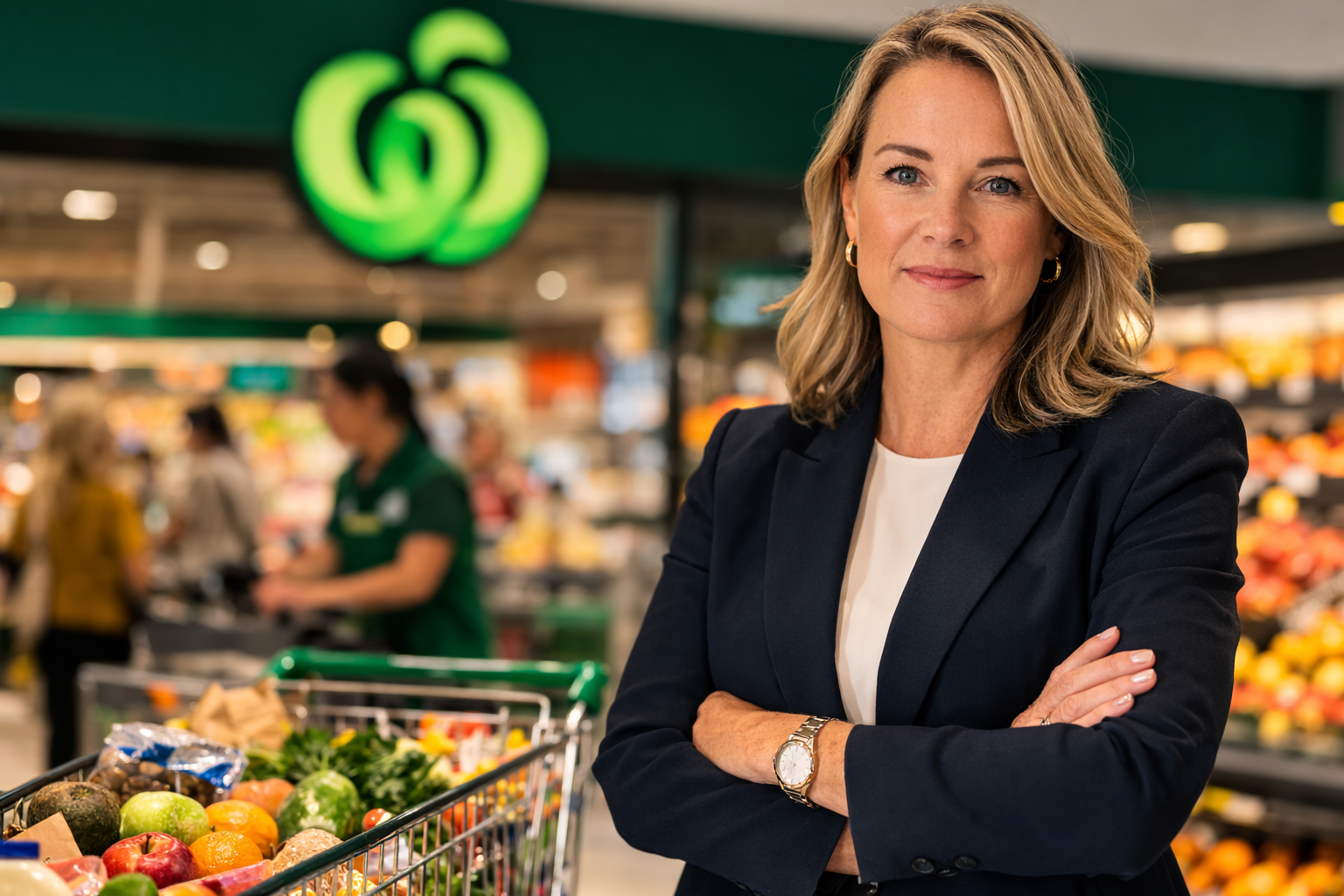
If you search “Woolworths CEO,” you probably want a name first. Fair enough. The current chief executive of Woolworths Group is Amanda Bardwell. That’s the quick answer. But the more interesting answer starts right after that, because being CEO of Woolworths in Australia right now is not a neat corporate title. It’s one of the most exposed jobs in the country.
So when a new CEO steps in, the story is never only about management. It’s about trust, cost of living, market power, logistics, digital habits, brand mood and the plain question of whether families feel they’re getting a fair go. That’s the strange thing about Woolworths leadership. It is a business role, yes, but it also ends up feeling like a social barometer.
And Amanda Bardwell arrived at exactly the moment that barometer was flashing a bit wildly.
Who is Amanda Bardwell, really?
Bardwell is not some outsider dropped in to shake the place up with imported management phrases and a fresh haircut. She is very much a Woolworths insider. She joined the group in 2001 and worked across the supermarket and drinks businesses before becoming the boss of WooliesX, the part of the company built around eCommerce, digital, rewards and loyalty.
That background matters more than it first seems. A classic supermarket chief might come up through store operations alone — stock flow, merchandising, supply chain and store labor. Bardwell does understand those things, but her public profile is also tied to the newer side of Woolworths: apps, data, digital shopping habits, personalised offers, loyalty mechanics, delivery, convenience and the whole changing way Australians buy food.
That makes her an unusually fitting CEO for this phase of Woolworths. The company is not only trying to sell groceries. It is trying to rebuild price trust, hold market share, make the in-store experience feel better, and keep digital convenience growing without looking like it has forgotten how ordinary households actually shop.
That is a bigger brief than “run the supermarket well.” It is more like: run the supermarket, the app, the delivery promise, the loyalty machine and the national mood at the same time.
| Leadership fact | What it says about Bardwell | Why it matters now |
|---|---|---|
| Joined Woolworths in 2001 | She knows the company from the inside | She is not learning the culture from scratch during a difficult period |
| Led WooliesX from 2017 | Her strength includes digital, eCommerce and loyalty | Woolworths now depends heavily on those areas for growth and customer stickiness |
| Became CEO on 1 September 2024 | She arrived during a reputational and competitive squeeze | Her leadership is being judged faster and more harshly than usual |
| First annual report in 2025 centenary year | She took over in a symbolic moment for the company | Big anniversaries tend to intensify questions about where the business is heading |
The job looks simple from outside. It isn’t.
From the outside, people often imagine the Woolworths CEO job as a giant but fairly clean retail role. Keep shelves full. Lift sales. Please investors. Don’t say anything silly. Done. But that misses how messy the supermarket business has become in Australia.
Woolworths is running inside a period where shoppers are highly price-sensitive, more willing to split baskets across multiple retailers, less loyal than they used to be, and much more cynical about discounts and promotional language. At the same time, costs across wages, energy, transport, shrinkage, supply chains and store execution are not sitting politely in the corner waiting to be ignored.
That means every major decision pulls against another one. Cut prices and you squeeze margins. Protect margins and people accuse you of losing touch. Invest in digital convenience and someone says the stores still don’t feel right. Push own-brand harder and someone worries about branded choice. Talk about trust and people ask why they stopped trusting you in the first place.
It’s a retail CEO job, sure. But it’s also a balancing act performed in public while millions of customers are effectively marking your work every week with their receipts.
- Price still matters more than almost anything else for shoppers.
- Execution still matters because “good value” means less if stock is patchy or stores feel tired.
- Digital still matters because convenience is now part of how people judge value, not separate from it.
That’s the real shape of Bardwell’s challenge. Not one problem. Several at once.
Why the “price trust” issue became so central
Here’s where the Woolworths CEO story stops being an executive profile and turns into a national business story. The company spent the past two years dealing with the reality that many Australian shoppers no longer felt instinctively warm about supermarket pricing. In cost-of-living conditions, that’s dangerous. Once customers start feeling that a supermarket is expensive, slippery or too clever with specials, the issue is bigger than any one weekly promotion.
It becomes emotional. A trust problem.
Woolworths has spent a lot of energy trying to repair that. Bardwell’s language around value has been consistent: invest in value, improve the fresh offer, lift in-store execution, make on-demand convenience more useful, rebuild trust. That tells you what the company thinks the job is. Not simply “sell more.” More like: make people believe the shop is worth choosing again.
The Lower Shelf Price program sits right in the middle of that strategy. First it launched on hundreds of products, then it expanded to more than 800 items. The idea is pretty clear. Don’t just run endless temporary specials. Lock in lower everyday shelf prices on enough familiar products that shoppers feel there is something solid under their basket, not only promotional noise dancing around the edges.
That is smart in theory. The harder question is whether it changes long-term customer feeling enough. Retail is full of strategies that sound rational in a presentation and take much longer to land in the public mind.
The ACCC shadow is still there, and that matters
You can’t write honestly about the Woolworths CEO in 2026 without dealing with the regulatory mood around supermarkets. The ACCC’s supermarkets inquiry and the separate court case over alleged misleading discount pricing claims changed the context for everyone running a major grocery chain. Even if the legal proceedings are separate from the inquiry itself, the effect on public conversation is obvious.
Suddenly supermarket leadership is not only about growth. It is about legitimacy. About whether people think the sector is fair. About whether pricing language feels honest. About whether the giant chains have been too comfortable for too long inside a market structure most households can’t escape.
That is a hard climate for any CEO, let alone one still relatively new in the top job. And it explains why Bardwell’s tone has often sounded less triumphalist than you might expect from the boss of a giant market leader. She is not leading a company in a celebratory mood. She is leading a company trying to prove that better execution and more dependable value can calm a fairly sceptical public.
| Pressure point | What Woolworths has to do | What Bardwell is really being judged on |
|---|---|---|
| Cost-of-living pressure | Show value in visible, repeated ways | Whether people feel their basket stretches further, not just whether ads say so |
| Regulatory scrutiny | Operate cleanly and communicate carefully | Whether Woolworths can look credible under public and legal examination |
| Competition with Coles and Aldi | Hold traffic and market share without wrecking margins | Whether Woolworths can stay strong without seeming defensive |
| Digital convenience | Keep eCommerce and on-demand useful and profitable | Whether convenience feels worth paying for, not just technically available |
| Store basics | Improve availability, freshness and execution | Whether the shopping experience feels tighter, cleaner and more reliable |
The August stumble and the February rebound told an important story
One useful way to understand Bardwell’s first stretch as CEO is to look at the contrast between the mood around Woolworths in August 2025 and the mood around it in February 2026.
In August, the company reported a 19 per cent fall in annual profit and the market reacted brutally. Sales growth was weaker than hoped, the share price copped a heavy hit, and the message from investors was pretty plain: the company’s attempts to rebuild customer trust were costing money, but they weren’t yet delivering enough of a visible retail payoff. That was a tough early verdict for a new CEO.
Then came the better half-year result in February. Sales rose, underlying profit improved, customer metrics improved, eCommerce stayed strong, and the language from Woolworths shifted slightly from repair toward progress. Not victory. Progress. That distinction matters. Nobody serious thinks Woolworths has fully solved the trust-and-value problem. But the February numbers at least suggested that the business was moving with more purpose, not just absorbing blows.
So Bardwell’s first big chapter has already had two distinct moods. First: this is harder than the company hoped. Then: there may be a workable path through. Business leadership often looks like that in real life — less heroic arc, more awkward, visible adjustment.
- The market punished Woolworths hard when the turnaround looked weak.
- It responded much more positively when the numbers showed clearer movement.
- That tells you investors are not writing Bardwell off, but they are impatient.
And honestly, they’re not the only ones. Customers are impatient too.
Her WooliesX background may be the whole point
There is a temptation to frame Bardwell’s digital background as a kind of side detail. It isn’t. It may be the central thing about her.
Woolworths is no longer only a store network. It is a giant customer-data business, a rewards ecosystem, an app-based ordering machine, a convenience service, a media and loyalty platform, and a logistics operation with a supermarket attached rather than the other way around. That’s a slight exaggeration, sure — but only a slight one.
And Bardwell comes from the part of the company built for exactly that reality. She understands the Everyday Rewards logic, the online shopping behaviour, the convenience model, the digital acquisition piece and the way data changes retail decision-making. That doesn’t automatically make her the perfect supermarket CEO. But it does mean she is unusually equipped for the shape Woolworths already has, not just the shape some nostalgic version of Woolworths had.
The question is whether a CEO formed in digital growth can also win the less glamorous war of in-store detail. Stock on shelf. Fresh quality. queue times. labour rhythm. store energy. Because for all the talk of eCommerce, Woolworths still lives or dies mainly by what happens when someone walks through the doors and pushes a trolley.
That’s the nuance. Her background is a strength, but only if it helps her fix the old-world basics as well as grow the new-world channels.
Why customers care who the CEO is, even if they say they don’t
Most shoppers will never read a Woolworths result announcement. They won’t know the difference between EBIT and NPAT and they do not care. Fair enough too. But they still care about the CEO in a more indirect way.
They care because the CEO sets the tone around what kind of supermarket they are dealing with. Price-first or margin-first. Defensive or honest. Digital-first or store-first. Slick or practical. Short-term or patient. The ordinary shopper may never phrase it that way, but they feel it.
When Bardwell talks about dependable value, on-demand convenience and in-store execution, she is not only talking to analysts. She is signaling what kind of Woolworths she wants people to think they are shopping with. Whether that signal fully lands is another question. But the tone absolutely matters.
And this is probably the strangest truth in Australian retail right now: shoppers can dislike supermarket power in the abstract and still strongly prefer one chain’s tone over another. The CEO influences that tone more than most people realise.
And what about the broader economy?
The Woolworths CEO role matters beyond Woolworths because the company is such a clean read on the Australian consumer. When Woolworths talks about value-seeking, own-brand strength, people shopping multiple retailers, strong eCommerce growth, softer tobacco sales, cautious households and pressure on the weekly basket, it is really describing the wider economy in miniature.
That’s one reason the market watches Woolworths results so closely. They don’t just tell you what Woolworths is doing. They tell you how Australians are living. Whether they are trading down. Whether they are chasing specials harder. Whether they are still spending on convenience. Whether household budgets feel looser or tighter. Whether shoppers are rewarding price cuts or just pocketing them and staying suspicious anyway.
So Amanda Bardwell’s job is not only to run a retailer. It is to read the country’s consumer mood quickly and react before that mood shows up too brutally in sales growth, margin pressure or lost loyalty.
That is why “Woolworths CEO” is a more interesting search term than it looks. It is really a search about the economy, disguised as a search about a person.
FAQ
Who is the current Woolworths CEO?
The current CEO and Managing Director of Woolworths Group is Amanda Bardwell.
When did Amanda Bardwell become CEO?
She was appointed in February 2024 and formally took over on 1 September 2024.
What did she do before becoming CEO?
She led WooliesX, which includes the group’s eCommerce, digital, rewards and loyalty businesses.
Why is the Woolworths CEO role so high-pressure?
Because Woolworths sits at the centre of cost-of-living pressure, supermarket competition, pricing scrutiny and daily consumer habits across Australia.
What is Woolworths trying to fix under Bardwell?
Mainly price trust, store execution, digital convenience, fresh performance and overall customer confidence.
What is the Lower Shelf Price program?
It is Woolworths’ effort to lock in lower everyday prices on a growing range of products rather than relying only on temporary specials.
Why do investors care so much about Amanda Bardwell’s results?
Because Woolworths is seen as a major read on the Australian consumer, and her performance gives clues about pricing power, competition and household spending.
Conclusion
Amanda Bardwell may be the current answer to the “Woolworths CEO” question, but the bigger story is what her job now represents. She is leading Australia’s largest supermarket group at a time when size is no longer enough, digital polish is no longer enough and even strong brand recognition is no longer enough. The company has to earn trust again in very practical ways.
That means price needs to feel believable. Stores need to feel tighter. Convenience needs to feel useful, not indulgent. And the business has to show that it can move through regulatory scrutiny and public scepticism without sounding either defensive or smug. None of that is easy. All of it is visible.
So yes, Woolworths CEO is Amanda Bardwell. But the more interesting answer is this: she now holds one of the clearest test jobs in Australian business. If she can make Woolworths feel fairer, sharper and more dependable again, that will say a lot about her leadership. If she can’t, it will say something just as important about how hard the modern supermarket business has become.