
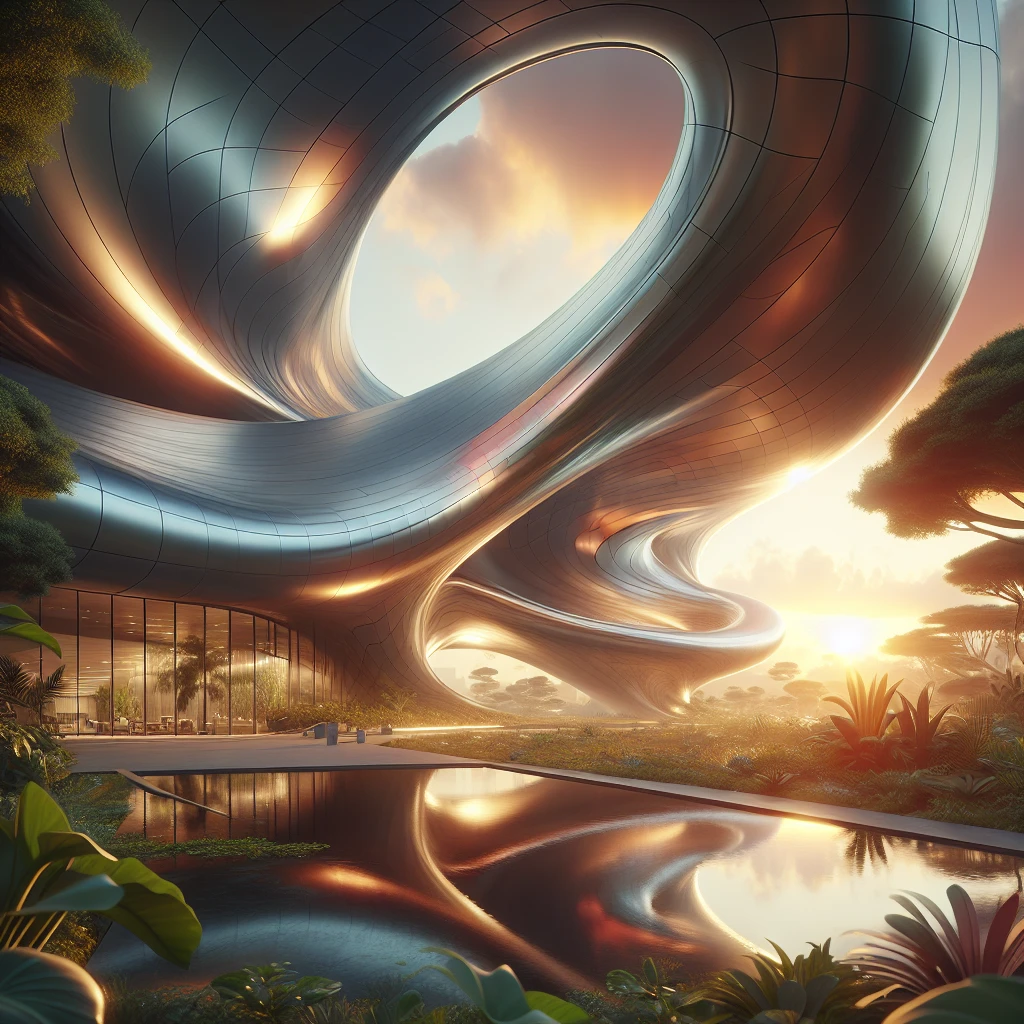
Why Greg Lynn Changed Architecture Forever
Have you ever wondered how buildings went from rigid, boring boxes to flowing, organic, dynamic shapes? You can thank greg lynn for that massive shift. If you are tired of looking at flat concrete walls, you are definitely not alone. I remember grabbing a coffee recently in Kyiv, wandering past some of the newer, fluid-looking facades popping up around the modern tech parks, and it instantly brought to mind the exact principles he introduced decades ago. His approach completely flipped the script on what a building could actually be.
Instead of relying on basic geometry like squares and triangles, he decided to bring motion, physics, and calculus into the mix. Imagine taking a solid block of clay and using a digital windstorm to carve out the rooms. That is essentially what he did using early animation software. It is absolutely wild to think about how much resistance he faced early on. Traditionalists hated it. They wanted predictable columns and standard roof lines. But he pushed forward, proving that structures do not have to be static. They can look and feel alive.
I want to chat with you about how he pulled this off, why it still matters so much, and how you can actually apply his way of thinking to your own creative projects. Trust me, once you start seeing the visual landscape through his lens, you will never look at a standard brick-and-mortar building the same way again. The concepts are mind-blowing, yet surprisingly grounded in real mathematics and physics.
The Core Concept: What Makes Greg Lynn Unique?
Let me break down exactly why his work stands out so dramatically from the rest of the pack. Before he came along, architects primarily used computers as highly expensive digital drafting boards. They were just drawing straight lines on a screen instead of on paper. Greg Lynn completely ignored that conventional approach. He started using animation software—programs originally designed for Hollywood special effects and video games—to generate architectural forms. He treated a building not as a stationary object, but as a frozen moment in a continuous flow of movement and environmental forces.
To really get a grip on his value proposition, look at two of his most iconic early examples. First, the Korean Presbyterian Church of New York. Rather than leveling the existing structure and building a standard box, he used digital algorithms to wrap a fluid, dynamic shell around the old framework, optimizing acoustics and sightlines simultaneously. Second, his legendary Embryological House concept. Instead of designing a single static blueprint that gets repeated infinitely, he designed a flexible geometric “seed” that could mathematically mutate to perfectly fit any specific plot of land, family size, or climate constraint. This was the birth of mass customization.
Here is a quick breakdown of how his methods compare to standard practices:
| Design Aspect | Traditional Architecture | Greg Lynn’s Approach |
|---|---|---|
| Primary Tools | AutoCAD, T-squares, basic geometry | Maya, Alias, kinematics, animation software |
| Form Generation | Static, algebraic proportions | Calculus-based, physics-driven forces |
| Manufacturing | Standardized parts, identical repetition | CNC milling, 3D printing, mass customization |
If you want to adopt his mindset, you need to internalize three fundamental principles:
- Calculus over algebra: Stop thinking in fixed shapes and start thinking in continuous curves and variables.
- Time-based generation: Allow digital forces like simulated wind, gravity, and traffic flow to sculpt your initial shapes.
- Mass customization: Build systems that easily adapt and mutate, rather than relying on one-size-fits-all blueprints.
It sounds wildly futuristic, but these principles have completely mapped out the modern design landscape we inhabit today.
The Deep History: Breaking the Mold
The Origins of Blobitecture
Let’s talk about where all of this actually started. In the early 1990s, the architectural scene was heavily dominated by Postmodernism and Deconstructivism. People were deliberately breaking buildings apart visually, creating sharp, chaotic, clashing angles. Enter greg lynn. He looked at that chaos and proposed a completely different alternative. In 1993, he guest-edited a famous issue of Architectural Design magazine titled “Folding in Architecture.” He argued for smooth, continuous complexity instead of aggressive fragmentation. He coined the term “blobitecture”—which sounds funny, but it comes from binary large objects (BLOBs) in computer graphics. He wanted seamless, flowing forms that adapted to their environment.
The Evolution of Digital Form
As the 1990s progressed, he began experimenting heavily with software like Alias and Wavefront. This was groundbreaking because these programs handled complex spline geometry, which allowed surfaces to stretch, pull, and deform without breaking. He was essentially borrowing the tools used to animate dinosaurs in Jurassic Park and applying them to rooflines and floor plans. By the time the early 2000s rolled around, his theoretical concepts started becoming physical reality. The advent of computer numerical control (CNC) machines meant that builders could finally fabricate the wild, curving panels that his software outputted. It was a perfect marriage of digital thought and physical manufacturing.
The Modern State of Architectural Design
Even now in 2026, the foundational concepts he introduced feel like the absolute baseline for any major firm. Every time you see a sweeping, organic stadium, a fluid cultural center, or incredibly ergonomic modern furniture, you are looking at the direct descendants of his early digital experiments. Software like Rhino and Grasshopper, which are industry standards today, exist largely because he proved that architecture needed to move beyond basic straight lines. He laid the tracks for parametric design, ensuring that future designers could seamlessly blend data, physics, and aesthetics into a single flowing entity.
The Scientific Reality: Math Meets Metal
Understanding NURBS and Spline Geometry
To truly appreciate what greg lynn achieved, you need to understand the underlying mathematics. You cannot draw a perfect blob with a compass and a straightedge. His work relies heavily on NURBS, which stands for Non-Uniform Rational B-Splines. It is a mathematical model commonly used in computer graphics for generating and representing curves and surfaces. Unlike a circle, which is defined by a center point and a radius, a NURBS surface is defined by control points that push and pull the surface like a magnetic field. This allows for incredibly smooth transitions and continuous curvature, ensuring that water sheds effectively and structural loads are distributed organically across the skin of a building.
The Physics of CNC Milling and Fabrication
Designing a beautiful digital blob is one thing; actually building it in the physical world is an entirely different beast. He bridged this gap by integrating architectural design directly with advanced manufacturing robotics. He utilized kinematics, essentially calculating the geometry of motion. Because every single panel on his buildings is totally unique, traditional manufacturing would be impossibly expensive. Instead, he sends the 3D data directly to CNC routers and robotic arms.
- Parametric Adaptation: Variables like sunlight angles automatically adjust the depth of window frames on a building’s facade.
- Toolpath Generation: The software automatically calculates exactly how the drill bit needs to move to carve a complex curve out of foam or wood.
- Structural Optimization: Digital physics engines simulate weight distribution, allowing the software to hollow out unnecessary material, making components both lighter and stronger.
- Seamless Assembly: Each unique piece is digitally tagged, ensuring construction crews can assemble the massive puzzle on-site without errors.
This deep integration of software and robotics is what makes his organic forms totally viable and fundamentally structurally sound.
7-Day Masterclass: Thinking Like Greg Lynn
If you want to inject this level of fluid, dynamic thinking into your own life—whether you are designing an app, making furniture, or actually planning a structure—you need a solid plan. Here is a seven-day blueprint to help you adopt his methodology.
Day 1: Abandon the Right Angle
Start your week by completely rejecting the 90-degree angle. Look around your space. Everything is likely a box. Grab a sketchbook and try to design a simple object—like a chair or a coffee cup—using only continuous, curving lines. Force yourself to think about how human hands or bodies actually interact with the object. Humans are not square, so our surroundings shouldn’t necessarily be either.
Day 2: Master Animation Software
You do not need to become a Hollywood animator overnight, but you should download a basic trial of a program like Blender, Maya, or Rhino. Spend a few hours just playing with spline tools. Create a flat surface and then use digital “magnets” to pull the mesh into a mountain range. Feel how the software wants to create smooth transitions.
Day 3: Introduce Environmental Forces
Now, let’s add some physics. In your software, apply a digital force like wind or gravity to your shape. Watch how the form deforms and reacts. This is the exact method greg lynn used to design the Embryological House. He let the environment shape the final product. Try to conceptualize how a heavy rainstorm or high foot traffic would physically erode or shape your design over time.
Day 4: Explore CNC Prototyping
You need to understand how the digital becomes physical. Find a local maker space or look up videos of CNC milling and 3D printing online. Notice how the machine translates your digital 3D model into physical toolpaths. Understanding this physical limitation will actually make you a significantly better digital designer.
Day 5: Study the Embryological House
Dedicate today to reading up on his famous Embryological House project. Look at how he defined a single mathematical formula that could spawn thousands of unique variations. Ask yourself: how can I apply mass customization to my own work? Can I create a template that effortlessly adapts to different clients rather than starting from scratch every single time?
Day 6: Design for Mass Customization
Take what you learned yesterday and build a system. If you are a graphic designer, create a logo that morphs slightly depending on where it is printed. If you are a coder, write a script that changes the UI based on the user’s local weather. The goal is to build intelligent variation into your core concept.
Day 7: Finalize a Fluid Concept
Bring it all together. Design one final concept—be it a product, a room layout, or a piece of art—that utilizes curves, responds to simulated physical forces, and is ready for digital fabrication. You are no longer just making objects; you are designing organic systems.
Debunking Architectural Myths
People often misunderstand the complexity of this style. Let’s clear the air on some common misconceptions.
Myth: Greg Lynn’s designs are just random blobs with no real thought behind them.
Reality: Every curve is meticulously calculated. The forms are actually the direct result of intense physics simulations and structural optimization. They are mathematical, not random.
Myth: It is physically impossible to build these shapes efficiently in the real world.
Reality: While it used to be difficult, the rise of 3D printing, CNC milling, and robotic assembly means these complex curves can be manufactured incredibly quickly and accurately.
Myth: Fluid architecture is just a passing aesthetic trend that will fade out soon.
Reality: It is the foundation of parametric design. The ability to calculate optimal forms using environmental data is permanently embedded in how modern engineering functions.
Myth: You have to be an advanced calculus genius to design like this.
Reality: The software handles all of the heavy mathematical lifting. Your job as a designer is to guide the parameters, set the limits, and sculpt the aesthetic outcome.
Rapid-Fire FAQ
Who exactly is Greg Lynn?
He is a pioneering American architect and professor who fundamentally changed the industry by introducing animation software and calculus-based geometries to building design.
What is blobitecture?
It is an architectural movement characterized by curved, rounded, fluid building shapes. It relies entirely on computer-aided design to calculate its complex geometries.
What software does he rely on?
Historically, he adapted Maya and Alias—programs built for the film and gaming industries—because traditional CAD software could not handle the complex splines and physics he required.
Where does he teach his methods?
He has taught at numerous prestigious institutions, including Columbia University, ETH Zurich, and the UCLA School of Architecture and Urban Design.
What is his most famous project?
The Embryological House is his most conceptually famous work, while the Korean Presbyterian Church of New York is one of his most recognized physical, built projects.
Does he design things other than buildings?
Absolutely. He applies his fluid, parametric methodology to industrial design, creating highly ergonomic furniture, sleek tea sets, and even experimental sailing yachts.
How did he impact modern furniture design?
By using digital fabrication, he proved that furniture could be customized to fit the exact contours of the human body, leading to sweeping, sculptural chairs that are both functional and artistic.
Look, whether you are trying to completely redesign your living space or simply looking for a fresh perspective on how things are made, diving into the world of greg lynn is guaranteed to spark some wild inspiration. His willingness to break the rules and merge technology with art is exactly what keeps our visual world moving forward. Take these concepts, fire up some software, and start bending your own reality today!